All posts by Zilver Phenix

Nervous Is Not Lying

Why modern “lie detection,” interrogation culture, and red-flag hypervigilance are scientifically false, ethically dangerous, and a violation of human rights.
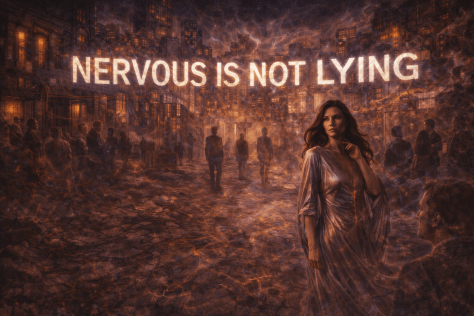
We live in a culture that believes it can see truth on the surface of people. Nervousness is treated as guilt. Inconsistency is treated as deception. Calm is mistaken for honesty. Social consensus is mistaken for evidence. Entire systems—legal, medical, social, and relational—are built on the assumption that stress, behavior, and “credibility” reveal moral truth.

Science says otherwise.

Decades of research show that humans are barely better than chance at detecting lies from behavior. Stress impairs memory retrieval. Interrogation and pressure manufacture false confessions. Polygraphs measure arousal, not honesty. Disability, trauma, and neurodivergence are systematically misread as deception. Groups regularly construct certainty without evidence, producing wrongful judgment, exile, and harm.

In recent years, this same logic has re-emerged in pop psychology and spiritual culture as “red flags”: the belief that hypervigilance and refusal to trust will reveal hidden danger. This article dismantles that superstition and shows how it mirrors interrogation culture—turning fear into authority and intuition into moral weaponry.

At its core, this is not a new truth. It is an old one, now confirmed by science: don’t judge. Not because truth doesn’t matter—but because humans are not built to reliably infer it from behavior, stress, or social reputation. When we forget this, we punish the vulnerable and mistake certainty for wisdom.

This piece is a call to end credibility testing as a cultural norm—and to replace it with epistemic humility, evidence-based inquiry, and basic human respect.


Preface: what this article is—and what it is not 

This is an evidence-dense argument against the everyday cultural practice (and many institutional practices) of treating stress physiology, demeanor, and narrative instability under pressure as proxies for deception. It is also an argument that inducing stress states—including sympathetic “fight/flight” overdrive—has been normalized as a tool for extracting “truth,” despite being harmful, coercive, and epistemically unreliable. The harms are not abstract: these practices can ruin reputations, relationships, employment, immigration outcomes, medical care, and legal cases, and they contribute to wrongful convictions, wrongful judgements, discrimination, and wrongful social exile that leaves people isolated and unable to sustain lives.

This article does not claim deception never occurs, or that accountability is impossible. It argues something narrower and more rigorous: human observers and many applied systems are not reliably detecting lying; they are often detecting stress, difference, and vulnerability—and mislabeling it as deceit.


1) The foundational problem: people are barely better than chance at judging lies from behavior 

The central myth is simple: “You can tell when someone is lying.” Popular culture teaches this constantly—eye contact, fidgeting, pauses, “inconsistencies,” tone shifts, flat affect, overexplaining, underexplaining, “not acting right.” But the scientific literature is blunt: demeanor-based lie detection performs near chance.

A landmark meta-analysis, “Accuracy of Deception Judgments” (Bond & DePaulo, 2006), synthesized 206 documents and data from 24,483 judges attempting to discriminate lies from truths “in real time” without special aids. The average accuracy was 54%, with people correctly classifying only 47% of lies as deceptive and 61% of truths as truthful (a “truth bias”).

Paper (journal page): https://www.aclu.org/sites/default/files/field_document/2006-Personality-and-Social-Psychology-Review-Accuracy-of-Deception-Judgements.pdf PubMed record: https://pubmed.ncbi.nlm.nih.gov/16859438/ 

That 54% figure is not a quirky artifact; it has become a reference point because it is repeatedly compatible with later summaries of the deception-detection literature. For example, “Self and other-perceived deception detection abilities…” (Scientific Reports, 2024) describes deception detection accuracy as tending to “hover around 54%,” with truths evaluated more accurately than lies due to truth-bias.

Humility is the first safeguard: obvious lies exist, but ‘I can tell’ is still a dangerous belief.

yes, sometimes deception is blatant—but the cultural habit of trusting intuition, demeanor, and social consensus is still error-prone and ethically hazardous.

Article: https://www.nature.com/articles/s41598-024-68435-2 

What this means in practice: even before we discuss police interrogation, polygraphs, “microexpressions,” or courtroom dynamics, the everyday act of “reading” someone is already operating at an error rate that is unacceptable for high-stakes decisions. When a culture teaches people to treat “nervous presentation” as evidence, it converts a weak inference into a social weapon.

2) Definitions: the physiology people are misreading as “guilt” 

To understand why so many “lie cues” are non-specific, it helps to name the systems being activated.

Sympathetic nervous system (SNS) activation is part of the autonomic response often described as “fight or flight.” It involves catecholamines (like adrenaline/epinephrine and noradrenaline/norepinephrine), shifts in heart rate, sweating, breathing changes, and altered attention/alertness. It is not a “lying system.” It is a threat response that can be triggered by fear, coercion, sensory overload, pain, trauma memories, authority intimidation, confinement, time pressure, and the sheer terror of not being believed. (Overview: https://www.sciencedirect.com/topics/psychology/fight-or-flight-response)

Stress biology is complex and variable across individuals. Sympathetic patterns differ by stressor type and person. The same outward “tells” can come from many internal states and can be amplified by disability or trauma.

Example review on sympathetic response patterns across stress tasks: https://pmc.ncbi.nlm.nih.gov/articles/PMC2577930/ 

The key epistemic point: if a signal is not specific to deception, then treating it as evidence of deception is scientifically unjustified. At best, it is ambiguous data; at worst, it is superstition with institutional authority.

3) Stress as a truth-finding tool is backwards: stress can impair memory retrieval and decision-making 

A large body of cognitive and neurobiological research shows that acute stress can alter memory retrieval and decision-making, sometimes in ways that look like “inconsistency,” “evasiveness,” “confusion,” or “non-cooperation.”

A systematic review focused on stress and long-term memory retrieval (“Stress and long-term memory retrieval: a systematic review,” Klier et al., 2020) summarizes the common finding that acute stress shortly before retrieval can impair retrieval, with timing and context mattering (fast responses vs slower cortisol-related effects).

Article (NIH/PMC): https://pmc.ncbi.nlm.nih.gov/articles/PMC7879075/ 

A neurobiological review of retrieval under stress (“Acute stress and episodic memory retrieval,” Gagnon & Wagner, 2016) describes how stress hormones and neuromodulators can change hippocampal, amygdala, and prefrontal function in ways that can degrade retrieval performance, especially in free recall conditions.

PDF: https://web.stanford.edu/group/memorylab/papers/Gagnon_YCN16.pdf 

Stress can also bias decision-making processes, shifting cognition toward habit-based responding and altering valuation and risk preferences (“Stress and Decision Making: Effects on Valuation, Learning, and Risk-Taking,” Starcke & Brand / later syntheses; one review accessible via NIH/PMC).

Review (NIH/PMC): https://pmc.ncbi.nlm.nih.gov/articles/PMC5201132/ 

Why this matters for “lie detection” culture: Many institutions—and many people—treat performance under pressure as a proxy for honesty. But performance under pressure is often a proxy for how someone’s nervous system behaves under threat, how their cognition functions when flooded, and whether the setting provides psychological safety. A stress-heavy interview can easily produce cognitive artifacts that look like deception: partial recall, scrambled chronology, delayed access to details, dissociation, shutdown, contradictory phrasing, or changes as memory reconsolidates.

If you manufacture sympathetic overdrive and then punish people for the cognitive and behavioral consequences of sympathetic overdrive, you are not “detecting lies.” You are creating dysregulation and then moralizing it.

4) Polygraphs: arousal measurement sold as lie detection 

A polygraph does not detect lies. It records physiological arousal through channels such as respiration, skin conductance (sweating), and cardiovascular activity. These are not uniquely caused by deception.

The National Research Council (part of the U.S. National Academies) evaluated the evidence in “The Polygraph and Lie Detection” (2003) and emphasized concerns about accuracy—particularly in screening contexts—and the serious problem of false positives (truthful people flagged as deceptive).

National Academies landing page: https://www.nationalacademies.org/read/10420 Example chapter page (false positives discussion): https://www.nationalacademies.org/read/10420/chapter/2 Another chapter discussing specificity and fear of false accusation: https://www.nationalacademies.org/read/10420/chapter/4 Full PDF copy (commonly circulated): https://evawintl.org/wp-content/uploads/10420.pdf 

The report explicitly points out that a polygraph outcome can be “positive” because someone is highly anxious—including anxiety driven by fear of being falsely accused—making the signal non-specific to deception (i.e., the test can’t cleanly separate “lying” from “fear”). That is not a technical nitpick; it is the core failure mode.

Disability and trauma implication: If a person’s autonomic system is atypical (e.g., dysautonomia), if they live with chronic hyperarousal, panic, dissociation, medication effects, pain, or trauma triggers, then physiological reactivity is not just “noise.” It is a systematic source of error that can be misread as guilt. In other words, polygraph logic easily becomes ableist by design when used as credibility judgment rather than as a narrow investigative tool with explicit uncertainty bounds.

5) “Microexpressions,” training programs, and the confidence trap 

Microexpressions are brief facial movements that can occur during emotional experience. Popular media and some training products market microexpressions as a gateway to detecting deception. The evidence does not support that level of promise—especially not in real-world screening.

A peer-reviewed study evaluating the Micro-Expressions Training Tool (METT), “A test of the micro-expressions training tool: Does it improve lie detection?” (Jordan et al., 2019), reports limited practical value and highlights issues like confidence increases without commensurate accuracy gains.

Public reporting around this research also underscored the concern: training can fail to improve lie detection beyond guesswork while still being used operationally.

Summary: https://www.hud.ac.uk/news/2019/september/mett-lie-detection-tool-flaws-street-huddersfield/ EurekAlert release: https://www.eurekalert.org/news-releases/888482 

This is the worst combination: a tool that increases perceived expertise without reliably improving correctness. The social consequence is predictable: more accusations, more certainty, more institutional reinforcement, and less humility about error.

6) Interrogation is not a neutral interview: it is often designed to produce admissions, not truth 

A crucial distinction that everyday culture often collapses is the difference between:

Interrogation: typically accusatory, pressure-based, often designed to obtain an admission/confession. Investigative interviewing: information-gathering, rapport-based, structured to elicit accurate accounts and reduce contamination and false confessions. 

Psychological science has documented how interrogation tactics can produce false confessions and how confession evidence powerfully biases downstream decision-makers.

A widely cited “white paper” review, “Police-Induced Confessions: Risk Factors and Recommendations” (Kassin et al., 2010), synthesizes findings about suspect vulnerabilities (e.g., youth, intellectual disability, certain mental health conditions), risky tactics (e.g., long interrogations, false evidence ploys, minimization), and why innocent people can be at distinctive risk.

PubMed: https://pubmed.ncbi.nlm.nih.gov/19603261/ PDF: https://web.williams.edu/Psychology/Faculty/Kassin/files/White%20Paper%20online%20%2809%29.pdf 

Kassin and colleagues published an updated review, “Police-Induced Confessions, 2.0” (2025), continuing the same central message: false confessions are real, vulnerability is patterned, and reforms are needed.

PDF: https://saulkassin.org/wp-content/uploads/2025/03/SRP2.0-Confessions-Kassin-et-al-2025.pdf 

The American Psychological Association (APA) issued “Resolution on Interrogations of Criminal Suspects” (2014), explicitly addressing false confessions and recommending reforms such as recording and safeguards, with attention to vulnerabilities and the science of interrogation.

What makes this ethically urgent: interrogation tactics often intentionally induce stress, confusion, and helplessness to break resistance. When institutions manufacture sympathetic overdrive, sleep deprivation, cognitive overload, fear, and “learned helplessness” dynamics, they are using the nervous system as a lever. That is coercive. And it is epistemically reckless because it can produce compliant speech rather than truth.

7) Wrongful convictions are not a theoretical risk: false confessions and false accusations are documented at scale 

It matters that this is not just “a lab effect.” Real-world data sources tracking exonerations repeatedly identify false confessions and false accusations/perjury as contributing factors.

The National Registry of Exonerations’ 2024 Annual Report (published April 2, 2025) reports, among other factors, that false confessions were involved in a portion of recorded exonerations and that perjury or false accusation was extremely common in those cases.

Report PDF: https://exonerationregistry.org/sites/exonerationregistry.org/files/documents/2024_Annual_Report.pdf 

The Innocence Project maintains accessible summaries of contributing factors in its exoneration work, including false confessions.

“Our Impact: By the Numbers”: https://innocenceproject.org/exonerations-data/ DNA exonerations overview with statistics and breakdowns: https://innocenceproject.org/dna-exonerations-in-the-united-states/ 

These are not merely “mistakes.” When a system treats coerced statements, pressured narratives, or demeanor-based suspicion as truth, it creates a pipeline where error becomes institutional fact.

8) “Credibility” as social consensus is not evidence—and can become coordinated social violence 

Many everyday harms do not even require formal legal proceedings. In workplaces, schools, hospitals, activist communities, families, and online spaces, credibility is often treated as a vibe: Who seems coherent? Who seems calm? Who seems likable? Who seems consistent? Who has social allies? Who performs normality?

That is not an epistemology. It is social power wearing the costume of rationality.

Hearsay is not evidence—because reliability collapses when stories propagate socially 

In formal law, hearsay generally refers to out-of-court statements offered to prove the truth of what they assert, and it is restricted precisely because it cannot be tested through cross-examination and reliability safeguards. (There are exceptions, but the structure of hearsay doctrine exists because “someone said someone said…” is notoriously fragile.)

In everyday life, people do the opposite: they treat repetition as proof. Group belief becomes “confirmation,” even when the underlying information is unverified, strategically edited, or maliciously coordinated.

Groups can lie 

This is the part polite culture avoids saying out loud, but it is true: collectives can falsify witness claims—to punish whistleblowers, to enforce conformity, to discredit marginalized people, to scapegoat a vulnerable person, or to protect a powerful actor. When societies teach that “multiple people saying it” equals truth, they create a weapon: manufactured consensus.

And when credibility is measured by performance under stress, disabled and traumatized people become ideal targets. Their bodies and narratives will “look wrong” to observers trained by myth, not science.

9) Disability, neurodivergence, and trauma: why “appearing deceptive” is often just difference under threat 

The discrimination you’re describing is not a side effect; it is structurally baked into how “credibility” is culturally computed.

Research shows that autistic people, for example, can be erroneously perceived as deceptive and lacking credibility due to differences in affect, eye contact, prosody, timing, and social reciprocity—features that many laypeople mistakenly treat as honesty signals.

“Autistic Adults May Be Erroneously Perceived as Deceptive and Lacking Credibility” (Lim, Young, & Brewer; Journal of Autism and Developmental Disorders; accessible via NIH/PMC): https://pmc.ncbi.nlm.nih.gov/articles/PMC8813809/ “Police suspect interviews with autistic adults: The impact of truth telling vs deception on testimony” (Bagnall et al., 2023; NIH/PMC): https://pmc.ncbi.nlm.nih.gov/articles/PMC10074602/ 

These findings are not “autism-only.” They generalize to many disability and trauma contexts: people who dissociate, who have autonomic dysregulation, who experience shutdown or freeze, who have alexithymia, who have speech/language differences, who are on medications affecting affect or cognition, who have chronic pain, who are sleep-deprived, who have executive dysfunction, who have Traumatic Brain Injury histories, who have seizure disorders, who have complex PTSD. The core point remains: many so-called deception cues are actually disability cues or stress cues.

10) A section on Zilver’s experiences

I live in a body that does not behave like the credibility fantasies people are trained to worship. I have a severe form of dysautonomia with vagus nerve dysregulation. I’m a human trafficking survivor of ten years. I deal with dorsal vagal and cortical disruption patterns that change what “access to memory” looks like in real time. Under pressure or at times of extreme pain, which is often for me— and especially under accusatory pressure or evaulation—my cognition can fragment. I can lose language. I can shut down. I can get brain fog. I can fail to retrieve linear chronology on demand. That doesn’t mean I’m lying. It means my nervous system is in a threat state, and the part of culture that calls itself “rational” refuses to recognize physiology as real unless it flatters their assumptions.

Interrogation doesn’t “bring out the truth” in me. It induces sympathetic overdrive and collapse dynamics that harm me and degrade my ability to communicate. When people see that and conclude “she’s changing her story” or “she looks dishonest,” what they are actually doing is punishing dysregulation. They are criminalizing my nervous system. They are treating the symptoms of trauma and disability as moral failure. And because they think lie detection is real—because they were trained by television, by pop psychology, by institutional myth—they feel entitled to their conclusion. They call it discernment. I call it discriminatory violence wrapped in certainty. It’s not just wrong; it’s dangerous. It primes other people to treat me and others like me as acceptable targets. It invites institutions to escalate. It licenses harm while pretending to be a search for truth.

11) Institutionalized “behavior detection” is a public example of science being ignored 

A culture that believes in lie detection will keep reinventing it—especially in security contexts—because it feels intuitively satisfying. But government evaluations have repeatedly flagged the lack of scientific validation for many behavior-based indicators.

The U.S. Government Accountability Office (GAO) reported that TSA did not have valid evidence supporting much of its behavior detection approach.

GAO (2017): https://www.gao.gov/products/gao-17-608r GAO report PDF: https://www.gao.gov/assets/gao-17-608r.pdf Earlier GAO (2013) on SPOT program: https://www.gao.gov/products/gao-14-159 

This matters because it shows the core dynamic: institutions deploy “behavioral indicators” at scale, with high-stakes consequences, without robust scientific grounding. The result is predictable: false suspicion is distributed onto the people who deviate from narrow norms—often disabled, traumatized, neurodivergent, mentally ill, culturally different, or simply terrified.

12) What replaces coercive interrogation and vibe-based credibility judgments: evidence-based, rights-based interviewing 

If society is serious about truth, it must stop using methods that are optimized for compliance and replace them with methods optimized for accurate information and human rights.

The Méndez Principles and the global shift away from coercion 

The Principles on Effective Interviewing for Investigations and Information Gathering (commonly called the Méndez Principles, adopted in 2021) explicitly present a rights-based alternative to coercive interrogations and aim to prevent torture and ill-treatment while improving investigative effectiveness. These are not meant to apply to day to day, social interactions, but scientific and authoritative investigations.

Official site: https://interviewingprinciples.com/ Principles 

These frameworks are not “soft.” They are disciplined. They treat interviews as a process that can contaminate evidence. They prioritize documentation, safeguards, presumption of innocence, and reliability.

The ethical pivot: coercion is not just abusive; it is epistemically corrupting. If you care about truth, you cannot treat nervous system destabilization as a tool.

13) What must change socially (not just legally): dismantling the myths 

A society that keeps “lie detection” myths alive will keep re-enacting them in homes, clinics, workplaces, and online communities—even when police reforms happen. This requires cultural change, not just procedural change.

A. Stop treating stress behaviors as moral evidence 

Nervousness, shutdown, confusion, flat affect, agitation, and memory disruption are not reliable indicators of deceit. They are indicators of state—physiological, psychological, contextual. Treating them as guilt is a category error.

B. Stop equating narrative inconsistency with lying 

Memory is reconstructive. Retrieval is state-dependent. Stress can impair access. Trauma can fragment encoding and recall. People can remember more later, or remember differently as they stabilize. This is not a license for anyone to say anything; it is a demand that we stop treating “performance of linearity” as virtue and “dysregulated recall” as sin.

Stress and retrieval impairment review: https://pmc.ncbi.nlm.nih.gov/articles/PMC7879075/ Stress and episodic retrieval neurobiology: https://web.stanford.edu/group/memorylab/papers/Gagnon_YCN16.pdf 

C. Stop letting “group consensus” replace evidence 

Collective belief is not a fact generator. It is a power amplifier. It can be sincere and wrong—or strategic and malicious. Social hearsay can function like a mob epistemology: “everyone knows” becomes justification for escalating harm. That is how reputations are destroyed and how institutions become vehicles for discrimination.

D. Stop using coercive pressure as “truth production” 

Interrogation that intentionally induces sympathetic overdrive, fear, exhaustion, or confusion is not a truth method. It is a compliance method with a known false-confession risk profile.

Kassin et al. white paper PDF: https://web.williams.edu/Psychology/Faculty/Kassin/files/White%20Paper%20online%20%2809%29.pdf APA resolution PDF: https://www.apa.org/news/press/releases/2014/08/criminal-suspects.pdf 

E. Recognize disability and trauma as protected contexts, not “suspicious behavior” 

If your “credibility detector” fails disabled people, your credibility detector is not neutral. It is discriminatory. The correct response is not to demand that disabled people mimic neurotypical calm; it is to stop treating neurotypical calm as evidence of honesty in the first place.

Autistic adults misperceived as deceptive (NIH/PMC): https://pmc.ncbi.nlm.nih.gov/articles/PMC8813809/ Police interviews and autism (NIH/PMC): https://pmc.ncbi.nlm.nih.gov/articles/PMC10074602/ 

14) Conclusion: the human rights claim 

Treating stress responses as guilt is not merely a “misunderstanding.” It is a social practice with predictable victims. It punishes the traumatized for being traumatized, the disabled for being disabled, and the neurodivergent for being neurodivergent. It turns physiology into suspicion and then pretends suspicion is truth.

Polygraphs do not read lies; they read arousal, and arousal is not specific to deception (National Academies, 2003). Demeanor-based deception judgments hover near chance (Bond & DePaulo, 2006; echoed in later summaries). Accusatorial interrogation can manufacture false confessions (Kassin et al., 2010; APA 2014). Institutions have deployed behavior-based suspicion systems without adequate scientific validation (GAO on TSA). Exoneration data repeatedly identifies false confessions and false accusations/perjury among contributing factors (National Registry of Exonerations annual reporting).

When society keeps treating these myth-based methods as legitimate, it normalizes harmful, coercive, discriminatory “credibility testing.” If we take evidence seriously and human rights seriously, this cannot remain acceptable “common sense.” It needs to end—not only in courtrooms, but in culture.


The Old Truth We Keep Forgetting: Don’t Judge 

When all of the science, ethics, history, and harm are stripped down to their core, what remains is not a new revelation. It is an old one—so old that many cultures arrived at it independently, long before modern psychology, neuroscience, or law: do not judge.

This principle was never naïve. It was not born of ignorance about deception or harm. It emerged from a sober recognition of human limitation. To judge another person’s internal truth from external appearance, behavior under stress, social reputation, or secondhand narrative has always been dangerous. Cultures encoded “don’t judge” not because truth does not matter, but because humans are not built to reliably infer it in this way—and because the cost of getting it wrong is borne by the vulnerable.

Modern science has not overturned this principle; it has validated it. We now know that people are poor judges of deception, that stress distorts memory and behavior, that nervous systems vary widely, that disability and trauma alter presentation, that groups amplify bias, that coercion manufactures false narratives, and that confidence is not accuracy. We know that credibility is often socially constructed rather than evidentiary, and that punishment frequently precedes proof. None of this contradicts the ancient warning. It explains why it existed.

“Don’t judge” does not mean “ignore harm,” “abandon accountability,” or “refuse investigation when necessary.” It means something far more precise and demanding: do not confuse perception with truth. Do not elevate intuition into authority. Do not convert stress into guilt, difference into danger, or social consensus into fact. Do not turn the limits of your own knowledge into certainty about someone else’s interior reality.

This is the line that interrogation culture crosses. It is the line polygraphs cross. It is the line demeanor-based credibility judgments cross. It is the line “red flags” ideology crosses. In every case, the same error is repeated: the belief that moral or factual truth leaks reliably through behavior, and that the observer is entitled to interpret it. History shows what follows when this belief is normalized—wrongful punishment, exile, discrimination, and violence justified by certainty rather than evidence.

To live by “don’t judge” is not to live without discernment. It is to live with epistemic humility. It is to accept that much of what matters about another person is not available to inspection, testing, or performance. It is to refuse the role of evaluator in ordinary human relationships, and to recognize that respect is not something people earn by passing credibility tests—it is a baseline ethical stance.

This is especially critical in a world where trauma, disability, neurodivergence, and systemic harm are widespread. When societies forget “don’t judge,” they inevitably punish the very people whose bodies and minds cannot perform safety on demand. They call this realism. They call it discernment. But it is neither. It is an old error wearing new language.

The most responsible position—scientifically, ethically, and psychologically—is not hypervigilance, not suspicion, not constant evaluation, and not blind faith in intuition. It is this: treat people as truthful unless evidence demands otherwise; investigate when necessary without coercion; and refuse to mistake certainty for truth.

In the end, there is no technique that will save us from the risk of being wrong about others. There is only how we choose to relate to that risk. “Don’t judge” is not a moral platitude. It is the only stance that consistently reduces harm in a world where human truth cannot be cleanly detected—and pretending otherwise has always been the real danger.


Yes, sometimes lies are obvious. That does not validate intuition-based “lie detection.”

Sometimes deception is blatant: a claim collapses under basic verification, a timeline is impossible, a person contradicts themselves within minutes, or independent records clearly refute what was said. This matters, because critics of deception-detection skepticism often argue as if the only options are naïve trust or omniscient suspicion. Those are not the only options. The point is not that deception never reveals itself. The point is that most everyday “lie detection” operates on demeanor and stress behavior—and science repeatedly shows that this is error-prone, often near-chance, and strongly shaped by bias. A person can appear anxious and be truthful; appear calm and be deceptive; appear inconsistent due to stress, disability, or trauma physiology; or appear consistent because they rehearsed. The ethical duty, therefore, is not to pretend we can’t notice obvious contradictions; it is to stop treating our intuitive confidence as evidence—especially when disability, trauma history, power imbalance, or coercive conditions are present. When we already know someone has reasons to dysregulate under pressure, it becomes negligent to interpret dysregulation as guilt, and doubly negligent to treat social consensus about their “credibility” as proof. In short: obvious lies exist, but the everyday belief “I can tell” remains scientifically weak and ethically dangerous.

Manufactured credibility, manufactured guilt, and the violence of social certainty

“Credibility” is often treated as though it is a property of the person—something they either possess or do not. In reality, credibility is frequently a social product, shaped by status, aesthetics, conformity, charisma, narrative fluency, and who has allies. This is why collective judgment is not a substitute for evidence: groups can be sincerely wrong, strategically wrong, or incentivized to conform. In social systems, reputational cascades happen: one story becomes “known,” repetition becomes proof, and dissent becomes suspicious. The result can be a shared certainty that is psychologically intoxicating—people experience moral clarity, belonging, and the sense of participating in justice—while the underlying claims remain unverified or even fabricated. This is how wrongful social exile happens: people are punished not for what is proven, but for what has become socially legible as guilt. When disability or trauma responses are involved, the danger intensifies. A dysregulated nervous system can be interpreted as “untrustworthy,” and that interpretation can spread like a contagion. In that context, it is an ethical requirement—not an optional kindness—to consider whether “credibility” has been manufactured by bias, misunderstanding, coercion, or coordinated social pressure. Hearsay and collective vibe are not evidence; they are vectors for harm.

The ethical middle path: trust without naïveté; skepticism without cruelty

There are two symmetrical pathologies that societies normalize. The first is arrogant “intuition”: the belief that one can reliably detect lies from behavior, reaction, or social impressions, despite strong evidence of error. This belief produces unjust suspicion, and it also produces misplaced trust—because skilled deceivers are often not caught by demeanor-based judgment at all. No person is immune to being deceived; there is no special class of humans who can reliably see through others in ordinary life. Treating oneself as a human lie detector is not mental sharpness; it is overconfidence that predictably harms others and often damages one’s own reality-testing. The second pathology is the opposite extreme: permanent skepticism that withholds basic respect, accommodation, or belief until exhaustive proof is produced. In everyday life, this is corrosive. It turns relationships into interrogations and makes connection impossible. It also becomes discriminatory when directed at disabled people or trauma survivors: demanding proof of disability before accommodation, or proof of victimization before basic dignity, forces people into a punitive burden that many cannot meet in real time—especially under stress. Rights and ethics do not require a person to prove their humanity to earn humane treatment. The only sustainable way to reduce harm is to accept a difficult truth: in ordinary life we cannot reliably detect deception, and we cannot build healthy relationships by constantly trying. We must choose a baseline of trust and respect—while still allowing that in special circumstances (high stakes, clear contradictions, safety concerns, legal contexts) careful verification is appropriate. Verification is not the same as suspicion-as-a-lifestyle. The goal is not to become credulous; it is to refuse coercive epistemology—refuse practices that treat people as objects to be “tested,” especially when those tests are known to misfire against disability and trauma.


These dynamics are not only destructive to their targets; they are corrosive to the people and groups who adopt them. Living in a state of constant suspicion, moral certainty, and narrative enforcement degrades collective reality-testing and individual judgment. When groups or individuals treat intuition as evidence and dissent as threat, they do not become safer or wiser—they become brittle, fear-driven, and increasingly detached from corrective feedback. This is not strength or discernment; it is epistemic instability normalized as virtue.

Ordinary human relationships cannot function under evidentiary standards designed for courts or security screenings; importing those dynamics into daily life is not realism, it is a breakdown of ethical boundaries.


The “Red Flags” Ideology: Superstition Disguised as Safety 

In recent years, a pseudo-psychological and quasi-spiritual ideology has gone viral in online culture—often framed as empowerment, self-protection, or emotional intelligence—under the banner of “red flags.” The claim is simple and seductive: if one maintains a state of constant skepticism, hypervigilance, and refusal to surrender trust, one will be able to detect danger, deception, or harm before it occurs. This belief system borrows the language of trauma awareness and psychology while discarding the actual science. What it produces is not safety, but a superstitious model of threat detection that mirrors—and amplifies—the same epistemic errors as interrogation culture and demeanor-based lie detection.

At its core, the “red flags” ideology assumes that danger announces itself through subtle behavioral cues, affective states, conversational irregularities, or perceived incongruence—signals that a sufficiently vigilant observer can learn to read. This is functionally identical to folk lie-detection beliefs: the idea that internal moral or relational truth leaks reliably through behavior, and that a watchful person can interpret those leaks correctly. As the scientific literature on deception detection, stress physiology, and social judgment already demonstrates, this assumption is false. Human beings are not reliable interpreters of internal states from external presentation, especially under conditions of uncertainty, fear, or projection. When people believe otherwise, they are not practicing discernment; they are engaging in overconfident pattern attribution.

The psychological cost of this belief system is substantial. Sustained hypervigilance is not a neutral cognitive stance; it is a stress state. Remaining perpetually alert for threat biases perception toward danger, increases false positives, and erodes the capacity for relational regulation. A person who refuses to surrender trust does not become more accurate—they become more suspicious. Suspicion feels like safety because it produces a sense of control, but control is not the same as truth. In fact, this posture often reduces accuracy by encouraging confirmation bias: ambiguous behavior is interpreted as evidence of danger because danger is already assumed. This is how ordinary human variance—awkwardness, nervousness, neurodivergence, trauma responses, cultural difference—gets reframed as moral or relational threat.

Crucially, the “red flags” framework also reproduces the same discriminatory dynamics discussed earlier in this article. Disabled people, traumatized people, neurodivergent people, and those with autonomic or cognitive differences are disproportionately flagged as “concerning” because their behavior deviates from idealized norms of calm, consistency, and emotional fluency. When these deviations are treated as intuitive warnings rather than as neutral differences, exclusion becomes morally justified. The ideology does not merely permit social exile; it aestheticizes it, recasting rejection and preemptive distancing as wisdom rather than harm. In this way, “red flags” culture functions as a socially acceptable mechanism for exclusion that requires no evidence and no accountability.

There is also a deeper epistemic danger: the belief that one’s intuition, once trained by vigilance, becomes especially trustworthy. This belief is psychologically reinforcing and socially contagious. People begin to mistake certainty for accuracy and confidence for insight. Entire communities can converge on shared narratives of danger without independent verification, mistaking consensus for truth. What emerges is not collective safety, but collective certainty divorced from evidence—a condition in which people feel morally authorized to judge, warn, and ostracize based on impressions alone. Historically, societies have always found ways to justify such dynamics; “red flags” simply provide a contemporary vocabulary.

At the same time, this ideology falsely promises protection from deception. It implies that constant suspicion will prevent betrayal or harm. The opposite is often true. Skilled deceivers are frequently adept at appearing calm, coherent, and reassuring—precisely the traits valorized by “green flag” aesthetics. Meanwhile, honest people under stress may appear uncertain, reactive, or inconsistent. Hypervigilance therefore fails in both directions: it falsely identifies danger where none exists and misses danger where it does. The belief that one can outsmart this reality through refusal to trust is not realism; it is magical thinking.

Equally harmful is the way “red flags” culture frames trust as naïveté and relational surrender as weakness. Human relationships cannot function as ongoing investigations. Trust is not the absence of discernment; it is the acceptance of epistemic limits. We do not build healthy connections by treating people as hypotheses to be tested indefinitely, nor by demanding proof of safety, goodness, disability, or victimization as a prerequisite for dignity. A life lived as a constant threat-assessment exercise is not psychologically healthy, nor is it ethically neutral. It externalizes fear onto others and normalizes evaluative surveillance as a mode of relating.

None of this is an argument against boundaries, accountability, or investigation when warranted. Special circumstances—credible evidence of harm, clear contradictions, legal or safety-critical contexts—require careful examination and verification. But a general lifestyle of suspicion, justified by the belief that danger can be intuitively detected through behavioral cues, is neither scientific nor humane. It is an extension of the same flawed logic that underlies coercive interrogation, polygraph superstition, and demeanor-based credibility judgments.

In the end, the “red flags” ideology offers a false bargain: permanent vigilance in exchange for safety. What it actually delivers is anxiety, misjudgment, relational impoverishment, and socially sanctioned harm—particularly to those whose nervous systems, communication styles, or histories do not conform to narrow expectations. A society serious about mental health, ethics, and human rights must be willing to say this plainly: hypervigilance is not wisdom, intuition is not evidence, and trust is not a moral failure.


On What This Ultimately Asks of Us 

What is being named here is not merely a flawed practice, but a deeper epistemic failure—one that underlies many forms of harm that have been normalized in modern society.

Societies have a long history of moralizing whatever they cannot accurately measure. When humans lack reliable ways to know another person’s internal truth, they rarely accept uncertainty. Instead, they invent proxies. Calm becomes goodness. Fluency becomes honesty. Consistency becomes virtue. Dysregulation becomes guilt. Confidence becomes trustworthiness (or untrustworthiness). These substitutions feel practical, even rational, but they are not. They are metaphysical shortcuts—ways of avoiding the discomfort of not knowing while still feeling justified in judgment.

The problem is not simply that these shortcuts are inaccurate. It is that they are dangerous.

Much of what has been examined in this article—demeanor-based lie detection, interrogation culture, credibility judgments, polygraphs, hypervigilant “red flags,” social consensus as proof—rests on the same refusal to tolerate epistemic humility. Each promises a way to bypass uncertainty. Each claims to offer control. And each reliably produces harm, especially to those whose nervous systems, bodies, or histories do not conform to narrow norms.

There is an uncomfortable truth beneath all of this: many people cling to intuition, suspicion, and judgment not because they work, but because they protect the ego from helplessness. Admitting “I cannot reliably know” feels threatening in a world that equates certainty with strength. Yet without that admission, ethics collapses. When humility is rejected, power rushes in to fill the gap.

A culture that cannot tolerate uncertainty will always persecute nervous systems that visibly carry it.

This is why these issues extend beyond science, law, or psychology. They are about how a society decides who is readable, who is credible, and who is disposable. They are about whether we treat human beings as opaque subjects—with interior lives we cannot fully access—or as objects to be evaluated, tested, and sorted.

History is unambiguous on this point: the fantasy that we can reliably judge truth, danger, or worth from appearance and behavior has never been benign. It has always justified cruelty while calling itself wisdom.

What this work ultimately asks is not technical reform alone, but moral restraint. A willingness to relinquish the comfort of judgment. A refusal to convert uncertainty into suspicion. An acceptance that no amount of vigilance will grant special access to other people’s inner realities.

If there is a boundary for a humane society, it is this:

We must stop treating people as readable problems to be solved, and start treating them as human beings whose truths cannot be extracted through pressure, performance, or perception.

Science supports this. Ethics demands it. And history warns us what happens when we ignore it.

Constant evaluative vigilance is not mental health.

A person or group that cannot tolerate uncertainty, that continuously scans for deception, and that treats suspicion as virtue is not exhibiting discernment—it is exhibiting cognitive distress. Chronic suspicion degrades judgment, increases false positives, and creates self-sealing belief systems resistant to correction. At the group level, this can resemble collective paranoia or moral panic: dissent becomes suspect, certainty becomes identity, and evidence becomes secondary to narrative coherence. This is not safety. It is psychological instability normalized as wisdom.


The Author, Zilver, experiences Dysautonomia.

This work is not theoretical for me. I have been systemically and socially wronged by these myths—treated as deceptive, unstable, or untrustworthy because my nervous system does not perform credibility under pressure. Those judgments did not remain abstract; they resulted in social exile, institutional harm, and loss of material support to the point that sustaining survival became difficult. This should never happen to anyone. The purpose of this article is not persuasion for its own sake, but harm prevention: to interrupt a cultural logic that licenses character assassination under the guise of discernment.

Dysautonomia, vagus nerve dysregulation, and autonomic variance Disability, trauma, neurodivergence, and misread credibility Group credibility, hearsay, social consensus Ethical middle path Red flags ideology Don’t judge (final conclusion) 

This placement ensures that dysautonomia is treated as central mechanistic evidence, not as an anecdotal or advocacy add-on.

Dedicated Section (insert as-is) Autonomic Variance and the Collapse of Demeanor-Based Judgment: Dysautonomia, Vagal Dysregulation, and the Myth of Behavioral Credibility 

Demeanor-based judgments assume a false premise: that human autonomic regulation is sufficiently uniform for behavior under stress to be meaningfully compared across individuals. This assumption collapses in the presence of autonomic variance, particularly in conditions involving dysautonomia and vagus nerve dysregulation. When autonomic function itself is unstable, externally observable behavior becomes an unreliable proxy not only for honesty, but even for baseline cognitive access, emotional regulation, and speech production.

Dysautonomia refers to disorders of the autonomic nervous system (ANS), which governs involuntary physiological processes including heart rate, blood pressure, respiration, digestion, thermoregulation, and aspects of attentional and emotional regulation. These conditions are heterogeneous and can involve abnormal sympathetic activation, parasympathetic withdrawal or dominance, impaired baroreflexes, altered vagal tone, and unpredictable shifts between autonomic states.

Overview (NIH): https://www.ninds.nih.gov/health-information/disorders/dysautonomia Clinical review: https://www.ncbi.nlm.nih.gov/books/NBK459259/ 

In individuals with dysautonomia, autonomic state is not reliably coupled to external context in the way assumed by most social inference models. A neutral question can provoke tachycardia, breath dysregulation, dizziness, cognitive fog, speech disruption, or shutdown. Conversely, high-stakes situations may produce blunted affect or delayed responses due to parasympathetic dominance or dorsal vagal activation. These responses are frequently misinterpreted as evasiveness, dishonesty, lack of cooperation, or emotional incongruence—despite being physiological, not volitional.

The vagus nerve, a primary component of the parasympathetic nervous system, plays a key role in modulating heart rate variability, emotional regulation, social engagement, and stress recovery. Disruptions in vagal signaling can profoundly alter how a person appears and functions under stress.

Neurophysiology review: https://www.ncbi.nlm.nih.gov/pmc/articles/PMC5894396/ Heart rate variability and vagal tone: https://www.ncbi.nlm.nih.gov/pmc/articles/PMC5624990/ 

While simplified popular frameworks (e.g., reductive interpretations of polyvagal theory) often distort these mechanisms, the core scientific point is well established: autonomic regulation shapes cognitive access, speech fluency, emotional expression, and behavioral timing. When autonomic regulation is unstable, demeanor ceases to be interpretable in normative terms.

This has direct implications for credibility judgments. Many cues culturally associated with deception—pauses, fragmented recall, monotone or flattened affect, inconsistent eye contact, delayed responses, over- or under-arousal—are predictable consequences of autonomic dysregulation, particularly under evaluative threat. Stress-induced sympathetic overdrive can impair working memory and retrieval, while parasympathetic shutdown can reduce verbal output and responsiveness.

Stress and memory retrieval impairment: https://pmc.ncbi.nlm.nih.gov/articles/PMC7879075/ Acute stress effects on cognition: https://www.ncbi.nlm.nih.gov/pmc/articles/PMC5201132/ 

Importantly, these effects are state-dependent, not stable traits. The same individual may appear articulate and coherent in a regulated context and disorganized or mute under pressure. Demeanor-based systems—interrogation, credibility assessment, “red flag” vigilance—treat this variability as evidence of deceit or manipulation, when in fact it reflects context-sensitive autonomic collapse. The judgment error is not incidental; it is systematic.

Polygraph logic exemplifies this failure at an institutional level. Because polygraphs rely on autonomic arousal measures, individuals with dysautonomia or altered vagal tone are at heightened risk of false positives. The National Academies explicitly note that fear, anxiety, and physiological reactivity unrelated to deception undermine specificity—yet applied contexts routinely ignore individual autonomic differences.

National Academies, The Polygraph and Lie Detection: https://www.nationalacademies.org/read/10420 

What makes this ethically severe is not merely inaccuracy, but predictable discrimination. When systems treat autonomic instability as suspicious, they effectively penalize people for the involuntary functioning of their nervous systems. This transforms disability into moral liability. It also incentivizes coercive stabilization demands—forcing individuals to perform calmness, coherence, and emotional regulation under threat—conditions that are physiologically unattainable for many.

The epistemic conclusion is unavoidable: behavior under stress is not a valid indicator of honesty when autonomic regulation itself is variable. Any framework—formal or informal—that ignores this reality is not just flawed; it is structurally incapable of fairness. In such contexts, “credibility” is not being assessed. It is being imposed.

Recognizing autonomic variance does not require abandoning truth-seeking. It requires abandoning the fiction that truth leaks reliably through behavior, especially under pressure. Until this shift occurs, demeanor-based judgment will continue to function as a covert mechanism of exclusion—mistaking nervous system difference for moral failure and calling the result discernment.


Horseback Archangels on New Years 2025 to 2026 Year of the Snake Transformation into Horse

Message from the Archangels on Horseback New Year

This image stands at the passage between years, where vision meets consequence and intention meets form.

Below, the serpent burns not as an enemy, but as exhausted creative force, the will that coils, imagines, and seeks control through endless refinement. It is the intelligence of the inner world brought to heat by overuse, asking to be released rather than driven further.

From this fire rises the horse, the embodiment of physical reality. It moves according to momentum, limits, and the laws of the tangible world. The horse carries what is real, not what is wished for, and demands participation rather than authorship.

Above, the archangel does not intervene. It witnesses. Wings open, hands unbound, it holds the space where judgment falls away and discernment begins. This presence marks the difference between energy and matter, between imagining a world and living within one.

Your reality is physical.

What unfolds in your visions is energy.

You must learn the difference.

Cease constant creation.

Cease control.

Surrender. Allow. Follow synchronicity.

Experience, rather than command.

Reciprocity is the nature of the universe.

Respect is not dominance it is trust in maturity and responsibility.

Respect yourself. Respect those around you.

Life is not an inevitable series of correct choices leading to success.

It is a gradual release into the true nature of the self…

a self that only emerges when judgment and evaluation fall away.

Realism and truth arise only when you remove the labels placed upon people, experiences, and yourself.

Much of what you defend as, self, is conditioning.

Do not fight to preserve it.

Do not confuse comfort purchased through harm, neglect, or avoidance for peace.

Do not choose coping strategies that sacrifice health or generate scarcity and suffering for others.

It is not your life versus another’s needs.

The physical world has limits.

Face what is tangible, and distinguish it from what is manufactured

by habit, fear, and inherited conditioning.

There is enough for everyone when those with excess stop wasting, and when false needs maintained only to avoid transformation are released.

You may manifest within energy,

but you cannot deny the material state of physical reality.

Master this discernment.

Cease all harm.

Stop disregarding suffering

for the sake of conditioned comforts

that soothe but do not heal,

that cope but do not grow.

Remember, growth is not easy.

Growth is painful.

Do not outsource the pain.

“The Fire Horse Burns the Wood Snake”

(Original Photoshop Painting and Authoring by Zilver Ascent Phenix of OtherWorldlyUniverse and AscentPhenix)

Portal Visions – Zita Scorpii by AscentPhenix Visionary Art – Scorpio Cosmic Energy

Welcome back to Otherworldly Universe.

I’m Zilver, the artist behind AscentPhenix, and today you’re entering the realm of Zita Scorpii, from the heart of the Scorpius Cluster.

This is Scorpio energy — transformation, memory, and rebirth.

The Zita Scorpii are a biomechanical species who evolve from metallic scorpions into iridescent humanoid beings of deep psychic power.

They float inside etheric spheres — cocoons of time and emotion — where they reconnect with their truest selves, across galaxies, across timelines.

Inside the sphere, she rests.

She remembers.

She transforms.

And when the vision clears…

She pierces the shell with her stinger — and the lost parts of her soul fall back to her body like stardust.

✨ This piece is part of my fundraiser series —

Your support helps me relaunch as a disabled, visionary artist + trafficking survivor.

🎯 Goal: $400 to fund

• Oracle deck printing

• NFT claim page listings

• Dreamcatcher & embroidery supplies

🌀 Each piece in this universe is a portal, available as prints, NFTs, and handmade ritual tools.

🌐 Support or share: ko-fi.com/ascentphenix

🖼 DM me about NFTs, dreamcatchers, or prints.


This is Zita Scorpii.

This is AscentPhenix — and this is just the beginning.

#visionaryart#psychedelicart#NFT#nativeamericanart#FantasyArt#scifiart#transcendental

Portal Visions 1 – The Fire Water Caves (First Version) by AscentPhenix Visionary Art

Welcome to the realms of Otherworldly Universe.
My name is Zilver Ascent Phenix, and you’re about to step into the fire and water caves of the Indigo Avian Phenix.

These visions come from the Starseed dimensions
etheric places where the soul travels when it’s ready to transform.

Each artwork reveals a woman who has astrally crossed into the Indigo Avian caverns,
where the water remembers everything,
and the fire burns away everything no longer needed.

Some descend into the water gently.
Others storm through it.

Every journey is different —
because healing doesn’t look the same on every body, every history, every heart.

Here, women of all forms, cultures, ages, and identities meet themselves fully —
feeling old emotions rise and swirl around them…
the things that were floating in their waters.

Then, when they are ready,
they move into the volcanic caverns —
and release it all in flame.

And from the fire…
a Phenix emerges.

This is the moment of rebirth —
the moment when you remember who you’ve always been.
Before pain.
Before silence.
Before survival.

The moment when power comes back home.

Every piece of art in this universe is a portal
a visual spell.
A doorway to inner alchemy.

They are reminders that transformation is not just possible —
it’s inevitable,
for those who choose themselves.

If these visions resonate with you,
there are more portals waiting:
oracle decks, NFTs, prints, and handmade dreamcatcher talismans
all created to bring this magic into the physical world.

Thank you for walking into the fire and water with me.
This is Ascent Phenix — and this is just the beginning.


🧡 Who I Am

I’m a Native American–raised visionary artist, neurodivergent and disabled.

For over 25 years, I’ve created digital and multimedia art, including:

  • 5,000+ finished artworks
  • 4 fully illustrated sci-fi, fantasy, and visionary universes
  • Oracle cards (which I call Portal Visions)
  • Dreamcatchers and embroidered ritual patches
  • Transformative dance, ritual, and performance art

Art is not a hobby for me — it’s my medicine, my voice, and my means of survival.


💫 How You Can Support My Rebirth

Right now, I’m raising funds for a small but powerful relaunch:

  • Printing my Oracle Card Decks (for sale in sets and bundles)
  • Manifold NFT Claim Page Listings (for minting visual portals)
  • Dreamcatcher + Embroidery Supplies (for physical product sales)

Once this is funded, I’ll finally be able to earn sustainably and independently again through multiple revenue streams.


🔗 Donate or Connect

If you’d like to help:

💸 Donate here → ko-fi.com/ascentphenix
✨ Ask me about NFTs or dreamcatcher commissions — DMs open!

The Ethics of Speaking About Others in Unequal Social Support Systems

A deep exploration of unequal social power, trauma-informed ethics, disability rights, and the invisible abuse of unsupported individuals through gossip, triangulation, and subtle social exclusion in households and communities

(image caption)”The Protected and the Erased”

This image represents the stark divide between those who are protected by unconditional love and those who are left vulnerable to social exile. Inside the glowing dome, people held in high regard move freely, untouched by conflict — their reputations immune, their place in the world secure. Outside, a single translucent figure stands alone, fading under the weight of judgment, whispers, and rejection — not because of wrongdoing, but because they spoke the truth in a system that punished them for it. The storm above them represents gossip, triangulation, and the weaponization of silence. Yet even in exile, they reach toward something greater: the distant tree of light, symbolizing the enduring strength of truth, human rights, and the sacred will to survive with dignity. This is not a story of weakness. It is a testament to the cost of speaking out when no one stands behind you — and the unshakable clarity of those who refuse to disappear quietly.

Some people walk through the world surrounded by a safety net. They have families who will always love them, no matter what happens. They have close friends who’ve been there for years, who’ve seen them at their worst, who forgive, who stay, who help them pick up the pieces when things fall apart. These are people who exist within unconditional love dynamics. And that matters — not just emotionally, but practically. That matters in every social interaction, especially when conflict or complexity arises.

When someone has access to that kind of support, they move through life with a certain insulation. They can make mistakes, go through hard times, experience misunderstandings, or have their names brought up in difficult conversations — and their world will not collapse. People might be upset with them. People might need space. But they will not be abandoned. Their core relationships won’t be undone by a single narrative or an emotional conversation had behind closed doors. Their people will continue to love them. Continue to offer presence. Continue to protect them from full social collapse.

This insulation creates a very important social distinction:
If you need to talk about someone — especially someone who has deeply affected you in a negative way — the safest and most ethical people to talk to are the ones who love that person unconditionally. These are the only people in the social web who can hear difficult truths without weaponizing them. These are the people who will not flip sides, sever ties, or reframe the person as irredeemable. They can hold complexity. They can hold love and critique in the same hand. They are capable of recognizing that hearing about someone’s harm doesn’t mean abandoning the person entirely. That’s what unconditional love makes possible: the ability to process, to reflect, to remain in connection despite challenges.

So if you’re Person B — someone who is struggling, hurt, or confused by Person A — and Person A is deeply loved by someone in their circle, it is not only reasonable but sometimes necessary to talk to that loved one. You might need to process what happened. You might need clarity. You might need to be witnessed. And the best person to speak to is someone who loves Person A so strongly that what you say will not jeopardize that relationship. That’s the safest path for everyone involved.

Now, let’s turn the mirror. Let’s look at the opposite dynamic — the one people so often ignore until it’s too late.

The Fragility of the Unsupported: What Happens When You Speak About Someone Without a Safety Net

There are people in every social structure — every household, community, group of friends, or chosen family — who are not surrounded by unconditional love. They may be new to the group. They may be considered strange, difficult, emotionally complex, mentally ill, poor, or simply not “one of us.” They may have no family, or no contact with the one they do. They may be carrying trauma, or navigating life with minimal resources. They may be tolerated more than embraced. These people live in a very different reality.

For them, there is no built-in cushion. No one who will take their side by default. No parent who will say, “I know who you really are.” No best friend who will call them after hearing something difficult and say, “I don’t care what anyone says — I still love you.” They live in a conditional social reality, where their belonging is always subject to review. Where one bad impression, one moment of emotionality, one distorted story can change how they are perceived permanently.

And so, when someone talks about them in private — even with the best intentions — there is a much higher risk of harm. The social network around them is not resilient. It is brittle, or even nonexistent. Speaking about them in ways that emphasize their flaws, struggles, or difficult behavior can instantly alter how they are seen. It can cause others to pull back, distance themselves, question their character, or decide quietly that this person is too much trouble to keep around. It can even push people to treat them with suspicion, condescension, or coldness, without ever confronting them directly.

The tragedy is that this often happens silently, invisibly, and without resolution. The person being spoken about may have no idea what changed, only that the energy has shifted. People stop responding. Opportunities vanish. Invitations don’t come. Their social survival is eroded, bit by bit.

And in more severe cases, this shift can lead to the loss of basic human needs:

  • They may lose housing, especially in shared living situations where emotional narratives influence group decisions.
  • They may lose access to community resources — rides, job referrals, emotional support, food.
  • They may be placed in situations of increased precarity, where being misunderstood doesn’t just hurt emotionally — it endangers their survival.

This is not an overreaction or paranoia. This is the reality for people whose relationships are conditional. For people who are not loved unconditionally, reputation is everything. And that reputation is often built or broken in quiet, private conversations where they are not present to explain, to defend, or to offer their side of the story.

Reputation Is a Form of Survival

In a world where not everyone is protected, reputation becomes a form of currency. And like currency, it can be destroyed in an instant. For those who lack deep social roots, a single narrative — true, false, or just emotionally charged — can undo years of effort to be included, trusted, or respected. It doesn’t matter if what is said is entirely factual. What matters is how it lands. What matters is whether the people hearing it have the emotional and relational depth to hold it without acting on it in harmful ways.

When someone lacks a support system, their entire livelihood may hinge on how a few key people see them. A moment of emotional venting, a comment made in frustration, or even a confidential conversation can trigger a chain reaction that removes them from the circle entirely.

That is why, when someone has no support, they must not be spoken about lightly — especially not to people who hold influence in their social world. If their connections are few, every connection is sacred. And speaking about them — even “harmlessly” — can do catastrophic harm.

Unequal Dynamics Require Unequal Responsibilities

In social systems where one person is surrounded by unconditional love and the other is not, the power imbalance is massive — even if it’s invisible. The person with support can survive almost any interpersonal rupture. The person without it may not survive even one. Therefore, the ethical responsibility is higher. The risk is asymmetrical, so the caution must be too.

If someone must process their experiences with a person who is deeply embedded in a social structure, the only fair place to do it is with those who love that person unconditionally — because they are the least likely to cause harm in return. They will not let the relationship collapse. They will not exile their loved one. They may listen, they may empathize, and they may not even agree — but their love will remain intact.

If, instead, someone chooses to process their feelings about a person with no safety net — especially with people who hold power in that person’s life — they may be contributing to a social injury with no path to healing. They may be taking away the only stability that person has left. And they may never know how much harm they’ve done, because the consequences often unfold in silence, and the unsupported rarely get a second chance.

Final Words: Speak with Awareness, or Do Not Speak at All

The core truth is this: in unequal social landscapes, words are not neutral.
To speak about someone with strong support is one thing.
To speak about someone without it is something else entirely.

If we want to live ethically, if we want to create social systems that are not quietly violent to the most vulnerable, then we must learn to recognize this difference. We must train ourselves to see where the safety is — and where it isn’t. We must understand that “processing” is not always harmless, and that “talking it out” can, in fact, exile someone from their only community. We must ask not just, “Do I need to say this?” but “What will happen to this person if I say this to the wrong person?” If you can’t answer that question with full awareness of the stakes, then maybe you shouldn’t say it at all.

Or maybe, just maybe, you should say it to the people who love unconditionally — because they are the only ones who can hear it without destroying someone in the process.

The Story of Person B: A Case of Exile in Uneven Social Dynamics

Person B lived in a house not because it was home, but because it was the last option before homelessness. Disabled, chronically ill, and with a long history of abuse, she had nowhere else to go. No family. No friends. No partner. No fallback. Her life had been an uphill battle through trauma and survival, and finally, she had found what seemed to be a sliver of stability — a room in a house shared with two people, Person A and Person A’s partner. It wasn’t ideal, but there was kindness, quiet, and some mutual understanding. Enough safety to begin healing. Enough stillness to survive.

But survival, when social structures are fragile, is never guaranteed.

Person A had a mother who visited often. This mother was not outwardly cruel — at least, not in ways people in her family were allowed to name. Her behavior was normalized, folded into family history as “just how she is.” She made pointed comments, cast judgments through suggestion, and demanded silent conformity to her unspoken rules. She was part of a larger family system that thrived on scapegoating — subtly designating one person as the cause of all discomfort so no one else had to look inward. Their love was conditional, but consistent — if you adapted, if you agreed, if you kept your discomfort to yourself.

However, this mother did benefit from unconditional love — from her daughter, Person A, and others around her. Despite her pattern of dysfunctional, controlling, and at times psychologically abusive behavior, her place in the social system was secure. She was protected, even when she caused harm. Her flaws were contextualized, softened, or excused. She was never at risk of social exile, never at risk of being alone. She was, in a very real way, untouchable.

Person B, on the other hand, had no such safety. And unlike the rest of the family, she could not conform to dysfunctional dynamics — not because she didn’t want to, but because people cannot ethically or psychologically be expected to accommodate or normalize communication styles and behavioral patterns that are inherently harmful. Dysfunctional dynamics — especially those rooted in gaslighting, scapegoating, triangulation, and silent judgment — are not simply a matter of opinion or “different values.” These patterns are objectively harmful, both socially and psychologically, especially for those who already exist in an unsupported position. Their damage is well-documented in trauma research, disability advocacy, and human rights frameworks. These are not quirks. They are violations of psychological safety.

To conform to such systems is to agree to one’s own erosion. And for Person B, this wasn’t metaphorical — it was medical. She had a severe stress-related heart condition that made prolonged interpersonal stress literally life-threatening. The demand to “just let things go,” to “not take it personally,” or to “just try to get along” wasn’t just emotionally unfair — it was biologically impossible.

She required peace and functional communication not as a preference, but as a survival need. And when the visiting mother repeatedly violated that need — through undermining, scapegoating, and subtle emotional abuse — Person B tried, carefully and calmly, to speak with her. To explain. To work it out.

But the mother saw this not as an attempt at mutual understanding, but as insolence. A challenge to her authority in the social hierarchy. In her worldview, people who didn’t silently endure her behavior were “difficult,” “manipulative,” or “too sensitive.” So she responded in kind — with escalation, not resolution. Her goal became not to understand, but to “put Person B in her place.”

Person B couldn’t comply with that demand, and she shouldn’t have been expected to. The dynamic was exploitative from the beginning: an outsider with no support being asked to suppress her survival needs in order to keep peace with people who had nothing to lose by ignoring them.

With no other option, Person B turned to the one person who might understand: Person A.

She did this not to create drama, not to divide anyone — but because she believed Person A’s unconditional love for her mother made it safe. She hoped that someone who loved the mother so strongly would be able to hold space for the truth without abandoning either party. After all, that’s the only safe place to speak when you’re vulnerable: in the presence of someone whose love is secure enough to handle it.

At first, it seemed to work. Person A listened. She expressed care. She even acknowledged that her mother had a pattern of mistreating people who didn’t adapt. For a moment, there was hope.

But that hope faded. Slowly.

The mother began retaliating in quieter, more insidious ways. She began speaking to Person A, and to the partner, behind Person B’s back. She suggested that Person B was “persuasive,” “manipulative,” or “controlling.” She reframed Person B’s boundaries as dramatics. Her survival needs became accusations. Her efforts to communicate were now seen as disruptions.

Over time, these narratives eroded Person A’s perspective. Whether from pressure, internalized loyalty, or emotional confusion, Person A began to shift. She didn’t say it outright, but her behavior changed. She pulled away. Her empathy thinned. She began to wonder — was her mother right? Maybe Person B was the problem. Maybe her intensity, her pain, her unrelenting need for clarity and peace meant she was “persuasive” in a bad way. Maybe she caused this.

And then came the worst betrayal: Person B was blamed for speaking up at all.

It wasn’t just that she was seen as difficult — it was that she was accused of creating the problem by speaking about the mother to someone in her own family. Her one act of self-protection — talking to the only person who could possibly listen — was now framed as disloyalty, manipulation, or “starting drama.” The irony was unbearable. Her survival strategy was painted as the harm itself.

As time passed, the household dynamic fully turned. Where there was once compassion, there was now coldness. Person B became the subject of subtle avoidance, irritation, and withdrawal. Her accommodations were no longer honored. Her boundaries were ignored. Her physical symptoms worsened. Her ability to work disappeared. Her pain flared. And she had nowhere else to go.

She was now the outsider again — but with even less than before.

This is not a story about someone being “too much.”

This is a story about social dynamics weaponized against someone with no safety net.
This is a story about what happens when dysfunction is tolerated, but disability is not.
This is about a person being exiled — not because they were persuasive, but because they had valid, non-negotiable health needs in a household built around ignoring them.
This is about powerloyalty, and the slow erosion of dignity when one person is protected unconditionally and another is left entirely exposed.

And it ends the way these stories always end:
The vulnerable person becomes the scapegoat.
The original harm is forgotten.
The silence becomes the weapon.
And the person who needed the most is the one left with nothing.

Doing the Right Thing: What It Looks Like to Choose Ethics Over Comfort

Person C had a friend, Person D, who was struggling.

Person D had recently moved into a shared living situation after barely escaping years of instability and harm. She was disabled, had no family, no partner, no financial safety net, and was dealing with serious chronic health issues that made emotional stress and social conflict physically dangerous. She was doing everything she could to maintain peace, follow rules, and respect others’ space. But she had limits — biological, psychological, and emotional — that made navigating a chaotic household dynamic increasingly difficult.

One day, Person C’s sister — who frequently visited and had a strong personality — started making indirect comments toward Person D. Passive-aggressive jabs. Judgment disguised as advice. Small, seemingly harmless things that slowly began to chip away at Person D’s sense of safety. It wasn’t explosive, but it was destabilizing. Person D’s health began to spiral. Her heart condition flared up. Her sleep stopped. Her panic attacks returned. Her stress levels became medically dangerous.

Finally, in desperation, Person D quietly approached Person C. She wasn’t trying to stir drama. She didn’t want to get anyone “in trouble.” She just needed someone to know what was happening — someone who loved the person causing harm but who might also care about protecting her life and stability.

And Person C did the right thing.

What did she do?

She didn’t react. She reflected.
She didn’t take the conversation as a betrayal of her sister. She didn’t become defensive. She didn’t question Person D’s motives or feelings. She understood that the only reason Person D came to her was because she trusted her — because she believed that Person C’s love for her sister was strong enough to handle a conversation without weaponizing it.

She listened. And then she validated.
She said things like:

  • “I understand how hard that must’ve been for you to bring up.”
  • “I know my sister can be intense. Thank you for telling me instead of bottling it up.”
  • “Your health and well-being matter here just as much as anyone else’s.”

And most importantly:

  • “Let me help make this safe for you. This is your home, too.”

Then what?

Person C didn’t go tell her sister everything Person D said.
She didn’t escalate it into gossip, conflict, or behind-the-back narrative spinning.
Instead, she approached her sister calmly and in private:

  • “I know you mean well, but some of the ways you’ve been speaking are stressing someone in the house who really needs peace to survive right now.”
  • “They have a medical condition that gets triggered by emotional tension, and I want to make sure we’re not doing anything that could hurt them unintentionally.”
  • “I’m not blaming anyone — I just want us to be mindful, because we all want this to be a livable, kind space.”

Her sister didn’t love hearing it, but because Person C didn’t frame it as a battle, the conversation stayed grounded. And even more importantly, Person C never let Person D become the scapegoat.

She made it clear to others in the household:

  • “Let’s not read into this or turn it into drama. She did what any of us would do — she came to someone who could help, safely, and said what she needed to survive.”

When others began quietly suggesting that Person D was “too sensitive” or “making things about her,” Person C interrupted:

  • “She has a right to exist in peace. If she’s the only one here without support, we need to be more careful, not less. That’s not weakness — that’s how we protect each other.”

What’s the Principle Here?

When someone has no backup, no one to protect their reputation, no one to hold their side of the story — you must hold it for them.
You must recognize that their voice carries no weight without yours, and that your silence will be read as agreement with whatever harm follows.

This is not about “taking sides.”
It’s about understanding that power is unequal. And in unequal dynamics, ethics means siding with the person who has more to lose.

When someone disabled, unsupported, and vulnerable tells you they’re being hurt — and they do it privately, carefully, and with trust — it is your responsibility to hold that moment with integrity.

That means:

  • Don’t reinterpret their survival as manipulation.
  • Don’t “balance the story” by gossiping with others who already hold social power.
  • Don’t frame their need for peace as a personality flaw.
  • Don’t let their legitimate boundaries be misrepresented as “drama.”
  • Don’t let other people rewrite the narrative just because they’re louder or more connected.

Instead:

  • Protect their place in the social fabric.
  • Reaffirm their needs.
  • Use your own privilege — of unconditional love, of credibility, of social immunity — to create safety they don’t have.

Because this is how we prevent exile.

This is how we create dynamics where the disabled, the unsupported, the trauma survivors, and the outsiders don’t have to disappear just to stay alive.

This is how we build spaces where speaking up is not a risk, but a right.

And this is how we honor trust — not just with the people we’ve always loved, but with the ones who risk everything to tell us the truth.

Final Point: This Is Not Drama — This Is Survival

When a person who is isolated — without friends, family, a partner, or social safety net — speaks up about harm, asserts their boundaries, or protects their survival needs, that is not drama.
It is not manipulation.
It is not persuasion.
It is not control.
It is not being “too sensitive.”
It is not overreacting.
It is not “creating conflict.”

It is survival.
It is protection.
It is a human right.
It is medical necessity.
It is what any human being has the right to do: advocate for their safety in a world where no one else is doing it for them.

When that person speaks to someone who loves their abuser or their aggressor unconditionally, they are not violating trust — they are choosing the safest possible route available in a dangerously unequal social structure. They are making a calculated, careful, and ethical choice, grounded in the belief that love strong enough to be unconditional can also be strong enough to hold complexity, discomfort, and accountability.

If that act is punished, reframed as manipulation, or used to turn others against them, then the harm has not only been repeated — it has been institutionalized.

And what is abuse, if not the institutionalization of injustice?

Let this be absolutely clear:

When an isolated, disabled, unsupported person is spoken about in ways that change the social energy around them — especially in a shared living environment — it is not “processing.” It is not “venting.” It is not a neutral act. It is a form of social violence.

If that shift makes them feel unsafe in their own home, if it pressures them out, if it degrades their access to basic respect, quiet, resources, or acknowledgment, then it is not just morally wrong —
It is abuse.
It is a violation of rights.
It is not an opinion.
It is not a preference.
It is not a matter of “both sides.”

In an unequal dynamic, where one person has everything to lose and the others have social immunity, truth is not subjective — it is structural. And when one person’s comfort is prioritized over another person’s capacity to live, we are no longer talking about misunderstandings.
We are talking about oppression.

To stand up for one’s rights in the face of that is not wrong — it is required.
To refuse to be silent is not antagonistic — it is ethical necessity.
To demand to exist without having to beg for basic accommodation is not a threat to the group — it is a declaration of dignity.

And when people in power — social, familial, or emotional — frame that act of survival as “drama,” what they are really doing is denying the humanity of the person who has no one else to defend it.

There is no excuse for this.
There is no justification.
There is no “other side” to the right to exist in safety.

Social Resources: Unveiling the Myths and Illusions — Refocusing Displaced Social Faith in Broken Systems

Social Resources: Unveiling the Myths and Illusions – Refocusing Displaced Social Faith in Broken Systems
Introduction: The Illusion of Social Resources
For many, the belief in the existence of widespread social resources is comforting. It’s easy to assume that for every person in need, there’s an established system ready to catch them—a safety net of charities, government programs, and services designed to ensure that no one falls through the cracks. This assumption creates an illusion: the idea that if someone is struggling, they simply haven’t looked hard enough, asked the right questions, or approached the right people.
In theory, it’s a reassuring notion. It suggests that society is structured to care for its vulnerable members, that no matter how difficult life becomes, help is accessible to everyone. It also allows people to maintain a comfortable distance from facing the reality of suffering. If the system is functional, then individuals don’t need to shoulder responsibility or confront the uncomfortable truth that someone might be left unsupported, with no options at all; and not due to their own shortcomings.
However, this belief crumbles when examined closely. Those who have tried to navigate these systems—those who have called the numbers, visited the offices, and filled out endless paperwork—know firsthand how inaccessible and ineffective these resources often are. They discover that eligibility is not universal, that requirements are restrictive, and that assistance, when it exists, is insufficient or takes years to materialize. The myth persists because it is easier for society to believe in it than to face the systemic failures and personal responsibilities it denies.
For individuals who are marginalized or living with invisible or rare conditions, the myth is especially damaging. It invalidates their lived experiences, blaming them for their struggles by implying that the help they need is readily available if only they would try harder. It creates a cycle of shame and frustration, forcing them to repeatedly prove their worthiness for help while simultaneously being told they don’t qualify.

The illusion of social resources is not just a misunderstanding—it is a societal coping mechanism. It shields people from the painful reality that community is the only true safety net we have. And yet, as this illusion persists, it perpetuates the marginalization of those who need support the most, leaving them isolated and unseen.

My Personal Journey Through the System
From the outside, people often assume that anyone in need can find help if they simply look for it. They imagine a world where resources are abundant, support systems are functional, and all it takes is a little effort to access them. But my experience has shown me how far this is from the truth. Over the years, I’ve explored every avenue, followed every lead, and exhausted every possible resource. I have lived in multiple states—California, Oregon, and Arizona—making countless calls, speaking to social workers, and reaching out to charities. Each time, I encountered the same barriers, the same closed doors, and the same systemic indifference.
I began my search by using the Internet to meticulously research available resources. I compiled lists, cross-referenced information, and left no stone unturned. I spent weeks, even months, calling hundreds of numbers, speaking with organizations and government offices. Each call was a grueling exercise in futility. I was passed from one person to another, told to call a different department, or informed that I didn’t meet the qualifications for their assistance. By the end of it, I had memorized the names and functions of every major program in every state I had lived in, and I could confidently say that there was nothing I had missed.
The most painful part of this journey wasn’t the lack of help—it was the way people responded to my struggles. Time and time again, I encountered individuals who believed that I must not be trying hard enough or that I simply wasn’t aware of all the resources available. They would suggest I call this or that organization, convinced that their one magical solution would change everything. I can’t count the number of times I’ve had to explain that I’ve already tried, already called, and already been turned away. Their disbelief wasn’t just frustrating—it was dehumanizing. It made me feel invisible, as if my efforts, my pain, and my reality were being dismissed.
I quickly learned that the system is not built for people like me. Social resources are designed with narrow criteria that exclude so many who desperately need help. If you’re not elderly, visibly disabled, a victim of specific, provable and recent legal circumstances, or part of a predefined category, the doors remain closed. Invisible illnesses, rare conditions, and complex situations don’t fit neatly into the system’s boxes. For someone like me, who is undiagnosed and misdiagnosed, the lack of recognition translates directly into the lack of support. It doesn’t matter how sick or in need you are—if you don’t have the paperwork to prove it, you don’t exist to these systems.
I’ve been told countless times that I should just go to the emergency room. But for someone with rare illnesses, the emergency room is not a solution. Doctors don’t know how to treat conditions they can’t easily diagnose. They might run a few tests, but when nothing conclusive appears, they send you home with no answers and no relief. Even for those who can afford to see specialists, the process of diagnosing a rare condition can take years—sometimes a decade or more. And for someone relying on state health insurance, accessing rare disease specialists is nearly impossible. The system doesn’t cover the kind of care required to uncover and treat rare illnesses.
Even transportation to medical appointments, something many people assume is readily available, is often out of reach. I’ve heard people suggest that I can just use a service to get rides, but in practice, these services are unreliable, inaccessible, or come with restrictive qualifications. It feels like every supposed solution is just another dead end.
The harsh reality is that there are no safety nets for people like me. What little support exists is not designed to address the complex, multifaceted struggles of someone in my position. It’s a system that looks good on paper but falls apart when put to the test. The resources that do exist are overwhelmed, understaffed, and often inaccessible. And the few people who manage to navigate these systems successfully become the exception that others cling to as proof that help is possible. But the truth is, for most of us, the system simply does not work.

This journey through the system has been degrading and exhausting. It has left me feeling not only unsupported but invalidated. It’s not just the lack of help that hurts—it’s the constant implication that the failure lies with me, that I must not be trying hard enough or that I must be missing something. The reality is that the system is broken, and the myth of its functionality allows society to turn a blind eye to those of us who are left behind.

Criteria for Accessing Resources and Why They Fall Short
To understand the myth of social resources, it’s important to look at the specific criteria that dictate who qualifies for assistance. The system is designed to help a narrow range of individuals, but even within those categories, the support is far from guaranteed. For the rest of us—those who fall through the cracks—there are no safety nets, only assumptions and false hope. Below, I’ll break down the major resources people believe are available and explain why they fail to serve those in need.
Major Categories for Resource Access
Elderly Support
Resources: Senior housing, Medicare, food programs, and transportation services.
Why It Fails: These programs are specifically for individuals above a certain age, often starting at 65. Even then, they are riddled with waitlists and bureaucratic hurdles. Those who are younger but suffer from disabilities or chronic conditions find themselves excluded entirely. Additionally, seniors with complex needs often require supplemental resources that aren’t covered by these programs.
Disability Support
Resources: Social Security Disability Income (SSDI), Supplemental Security Income (SSI), housing assistance, and Medicaid.
Why It Fails: The key issue here is that you must be formally diagnosed and deemed “unable to work.” The process of getting a diagnosis can take years, especially for rare or invisible illnesses. Even with a diagnosis, many people are denied benefits because they don’t meet strict definitions of disability. For those with intermittent or fluctuating conditions, being considered “able-bodied” by default is the norm, regardless of the actual impact on their lives.
Domestic Violence Victims
Resources: Emergency shelters, legal aid, housing programs, and counseling services.
Why It Fails: These program require specific, provable and recent circumstances, such as police reports or restraining orders. For those who don’t fit the legal definitions of domestic violence, even if their situation is violent or unsafe, there is no access to these resources. Shelters are overcrowded, often dangerous, and provide only temporary relief, not long-term solutions.
Parents with Children
Resources: WIC, SNAP, childcare subsidies, and housing assistance.
Why It Fails: While parents with minor children have access to certain resources, the system assumes that adults without children are less vulnerable or less deserving of help. For those without dependents, these options are entirely inaccessible. Additionally, even for parents, these programs are often insufficient to cover basic needs or require income thresholds that exclude many families struggling to get by.
Recovering Addicts
Resources: Rehabilitation programs, transitional housing, job placement, and counseling.
Why It Fails: These resources are limited and often short-term, focusing on acute recovery rather than sustainable living. Those who don’t have a history of substance abuse but are still struggling find that these programs do nothing for them.
Deemed Mentally Ill
Resources: Mental health services, disability income, and housing assistance.
Why It Fails: This category relies heavily on a formal diagnosis, and even then, resources are scarce. Many people with mental health conditions don’t receive the support they need because they don’t fit into the most extreme cases. Furthermore, society often pressures those without a mental illness diagnosis to claim one just to access help, which is degrading and does nothing to address the actual root issues.
The Illusion of Accessibility
Even within these categories, the reality is that access to resources is far from guaranteed. Here’s a closer look at why:
Long Waitlists
For housing programs like Section 8, waitlists can span years, if not decades. By the time someone’s name comes up, their situation may have drastically changed—or they may no longer be alive to benefit from the assistance.
Rare Illnesses and Undiagnosed Conditions
Medicaid, the supposed safety net for low-income individuals, does not cover specialists for many rare conditions. This means people with complex medical needs are left without answers or treatment. Even if they pay out of pocket for a diagnosis, proving a disability to qualify for resources is an uphill battle that many lose.
Overcrowded Shelters and Services
Emergency shelters are often overcrowded, unsafe, and provide little more than temporary relief. People with specific needs, such as dietary restrictions or health conditions, find these environments impossible to navigate.
Geographic and Bureaucratic Barriers
Many resources are only available in specific areas or require extensive documentation that is difficult for someone in crisis to obtain. Transportation to appointments or offices is another major hurdle, especially in rural areas.
Stigma and Dehumanization
Accessing these resources often requires degrading oneself, jumping through endless hoops, and facing judgment from those who are supposed to help. For many, the process itself is traumatic and disempowering.
The Reality for Those Who Don’t Qualify
For people like me, who don’t fit into any of these categories, the message is clear: You don’t exist in the eyes of the system. There is no help, no safety net, and no acknowledgment of the complexity of your situation. The only “solutions” offered are generic, one-size-fits-all options like food boxes or homeless shelters, which do nothing to address the root causes of the problem.
The myth of social resources allows society to shift the responsibility for community care onto broken systems that were never designed to meet everyone’s needs. It creates the illusion that help is out there, but for most of us, it’s a mirage—a promise that disappears the closer you get to it.

By understanding the limitations and failures of these resources, we can begin to challenge the narratives that uphold them and advocate for real, meaningful change. True community care cannot be outsourced to systems that were never intended to support the people who need them most.

Comprehensive List of Resources and Why They Fail the Average Person

  1. Housing Assistance Programs
    Resources: Section 8 Housing Choice Voucher Program, Rapid Re-Housing, Transitional Housing, Emergency Shelters.
    Why They Fail:
    Section 8: The waitlists are notoriously long, taking years or even decades to access. Preference is given to families, veterans, or those with specific disabilities, leaving the average single adult without access.
    Rapid Re-Housing: Designed to provide short-term rental assistance for people experiencing homelessness, but funding is limited, and most programs prioritize families with children or those fleeing domestic violence making this inaccessable to most people.
    Transitional Housing: These programs are often for recovering addicts or recent domestic violence victims, not for people who don’t fit those criteria.
    Emergency Shelters: Shelters are overcrowded, unsafe, and often have strict rules about curfews or mandatory participation in religious activities. For someone with specific health needs for isolation or belongings, this is not a viable option.
  2. Food Assistance
    Resources: SNAP (Supplemental Nutrition Assistance Program), Food Banks, WIC (Women, Infants, and Children).
    Why They Fail:
    SNAP: Qualification requires strict income thresholds that exclude people who may still struggle to afford food but don’t fall under the federal poverty line. Additionally, the benefits often cover only a fraction of monthly food needs. There is also often a requirement to do a 20 hour a week job search and seek employment, which is not viable for people who are undiagnosed and not deemed offically disabled but are still unable to function in this manner.
    Food Banks: While food banks provide some relief, they are often overcrowded, understocked, and only offer sporadic or inconsistent aid. Many food banks distribute food that doesn’t cater to dietary restrictions or allergies.
    WIC: Specifically for pregnant women, postpartum women, and young children, leaving single adults or those without dependents entirely out of the equation.
  3. Medical Assistance
    Resources: Medicaid/Medi-Cal, Emergency Rooms, Free Clinics.
    Why They Fail:
    Medicaid/Medi-Cal: These programs are income-based, and even when someone qualifies, they rarely cover specialists or complex medical needs, such as rare diseases. The long wait times to see a doctor often make it impossible for people to receive timely care.
    Emergency Rooms: While emergency rooms are obligated to stabilize patients, they do not provide long-term treatment. Chronic conditions, rare illnesses, and preventative care are ignored, leaving the root problems unresolved.
    Free Clinics: These clinics often provide only basic care and are overwhelmed by demand. Appointments are hard to secure, and they rarely offer services beyond general check-ups and basic medical care for easily known or detectable illnesses.
  4. Financial Assistance
    Resources: General Relief (GR), Temporary Assistance for Needy Families (TANF), Charitable Organizations.
    Why They Fail:
    General Relief (GR): GR provides minimal cash aid (sometimes less than $200 a month) and is often available only to single adults without dependents who can prove they are actively seeking work. It is not enough to cover basic living expenses.
    TANF: This program is strictly for families with children, meaning single adults or childless couples do not qualify.
    Charitable Organizations: Most charitable organizations have limited funding and focus on specific demographics, such as veterans, children, or domestic violence survivors. The average person without these labels often cannot access these funds.
  5. Transportation Assistance
    Resources: Non-Emergency Medical Transportation (NEMT), Local Ride Programs.
    Why They Fail:
    NEMT: Only availablein certain areas with limited availability, to Medicaid recipients and generally limited to medical appointments, leaving those without Medicaid or those who need rides for other critical purposes (e.g., grocery shopping) without options.
    Local Ride Programs: These are often underfunded, unreliable, or require advance scheduling that doesn’t accommodate emergencie, last-minute, or other survival needs.
  6. Job Placement and Vocational Programs
    Resources: Workforce Development Programs, Vocational Rehabilitation, Nonprofit Job Placement Services.
    Why They Fail:
    Workforce Development Programs: These programs often require participants to meet specific criteria, such as being unemployed for a certain period or qualifying as low-income. Many only offer minimal support, like resume-building workshops, without addressing deeper barriers to employment.
    Vocational Rehabilitation: Typically reserved for individuals with disabilities, leaving others with barriers to employment (e.g., lack of transportation or childcare) without support.
    Nonprofit Job Placement Services: These services are often limited to specific populations, such as veterans or refugees, and don’t address the unique needs of neurodiverse or chronically ill individuals.
  7. Mental Health Services
    Resources: Community Mental Health Centers, Crisis Hotlines, Counseling Programs.
    Why They Fail:
    Community Mental Health Centers: Limited by funding and often overwhelmed by demand, these centers prioritize severe cases, often leaving those with moderate needs untreated.
    Crisis Hotlines: While they attempt to provide immediate emotional support, they do not offer long-term solutions or resources; and often the councelor or advocate can only offer robot and very limited responses that lack actual human connection or true answers.
    Counseling Programs: Free or low-cost counseling services are scarce, with long waitlists and minimal session limits that don’t allow for meaningful progress. Counceling also does not solve the logical problems in someone’s life.
    Why the Average Person Doesn’t Qualify
    The common thread in all these resources is that they are designed with specific categories of people in mind, leaving everyone else excluded. If you are not elderly, a parent, disabled, recovering from addiction, or a domestic violence survivor, the system offers nothing for you. Even those who do fit into these categories often face insurmountable barriers to access.
    For individuals who are chronically ill but undiagnosed, neurodiverse but without a formal label, or simply struggling without meeting specific criteria, there are basically no social service pathways to support. The system is built on a rigid framework that ignores the complexity of real-life struggles. It is not designed to help everyone who is struggling and in need—it is designed to manage the optics of helping without addressing systemic issues.

By breaking down these resources and their inherent limitations, it becomes clear that the myth of social resources is just that—a myth. The reality is that most people who fall through the cracks have no safety net, no support, and no acknowledgment from a society that insists help is always available if you just “look hard enough.”

Barriers to Diagnosis and Support: A System Designed to Fail Those in Need

  1. Rare Illnesses and the Challenges of Diagnosis
    Rare illnesses represent one of the most difficult hurdles in accessing support because the medical system is not structured to accommodate complexity or uniqueness. Rare illnesses are often misunderstood, misdiagnosed, or completely overlooked due to their uncommon presentation. Patients with rare conditions must navigate an overwhelming array of obstacles, including dismissive doctors, inadequate testing, and a lack of funding for research into their specific conditions.
    Dismissive Medical Professionals:
    Many individuals with rare illnesses report being dismissed by doctors who attribute their symptoms to anxiety, stress, or other psychological issues. This leads to a dangerous cycle where the patient is not believed, their symptoms worsen, and they are left without a diagnosis or treatment plan.
    Limited Testing Availability:
    Rare illnesses often require specialized diagnostic tests that are either unavailable in most medical facilities or prohibitively expensive. These tests are often not covered by insurance, including government programs like Medi-Cal, which most often only provides the most basic diagnostic tools.
    Lack of Specialist Knowledge:
    Most primary care physicians are not trained to recognize or treat rare illnesses. Specialists, such as geneticists or neurologists, are often required for proper diagnosis, but accessing these specialists is a significant challenge due to cost, location, and availability.
  2. The Limitations of Medi-Cal and Access to Specialists
    Medi-Cal, California’s Medicaid program, is often presented as a solution for low-income individuals seeking medical care. However, its limitations are glaring, particularly for those with rare illnesses or complex conditions.
    No Coverage for Many Types of Specialists:
    Medi-Cal rarely covers the cost of rare disease specialists or the advanced testing required for rare illness diagnosis. For example, a patient with an undiagnosed heart condition may need a specific type of cardiologist, geneticist, or a specialized imaging test, none of which Medi-Cal reliably covers.
    Long Wait Times:
    Even when Medi-Cal does cover specialist visits, the wait times can stretch for months or even years due to an overburdened system and a lack of participating providers. This delay can lead to a worsening of symptoms and even permanent damage.
    Geographic Disparities:
    Many specialists who accept Medi-Cal are located in urban areas, making it nearly impossible for rural residents to access care. Medi-Cal does not provide adequate transportation assistance, leaving patients stranded without options.
  3. The Long Timelines of Rare Illness Diagnoses
    One of the most disheartening realities for individuals with rare illnesses is the time it takes to receive a proper diagnosis. Studies show that it can take seven to ten years or on average to diagnose a rare illness, a timeline that is utterly devastating for those in need of immediate care. Sometime’s it can take even longer or the person dies while trying to get diagnosed.
    The Diagnostic Odyssey:
    Patients are often sent from one doctor to another, repeating their symptoms and undergoing redundant or inappropriate tests. Each misstep adds to the delay in diagnosis and treatment as well as being exhausting, discouraging, and dehumanizing.
    Emotional and Financial Strain:
    The long diagnostic process takes a toll not only on the patient’s health but also on their mental well-being and financial stability. Many patients spend thousands of dollars on out-of-pocket medical expenses, only to remain undiagnosed and untreated.
    The Gap in Support:
    During this diagnostic period, patients are left in limbo. Without an official diagnosis, they cannot access disability benefits, specialized care, or even acknowledgment of their struggles. This gap in support leaves them to fend for themselves while their condition worsens. As if their disability does not exist because it has not been proven in these systems.
  4. The Difficulty of Proving Disability
    Even when individuals manage to receive a diagnosis, proving disability to government programs like Social Security Disability Insurance (SSDI) or Supplemental Security Income (SSI) is an entirely separate challenge.
    The Burden of Proof:
    Disability programs require extensive documentation, including medical records, doctors’ statements, and evidence of functional limitations. For individuals with rare illnesses, obtaining this documentation is often impossible due to the lack of specialists or diagnostic clarity.
    Able-Bodied Bias:
    Disability determinations are often influenced by visible signs of impairment. If a person appears able-bodied—walking, speaking, or functioning in a way that doesn’t immediately suggest disability—they are often denied, regardless of the severity of their symptoms. And yet at the same time, we live in a society that conditions us to mask our disability or face scorn as well.
    Denials and Appeals:
    Initial applications for disability benefits are most frequently denied, forcing individuals to go through a lengthy appeals process. This can take years, during which the individual receives no financial assistance and often loses hope of ever being approved. Many people die while attempting to navigate this process and never receive relief and support.
  5. Able-Bodied Bias and the System’s Exclusion
    The able-bodied bias within society and government programs creates significant barriers for those whose disabilities are invisible or fluctuating.
    The Misconception of Ability:
    Society often equates disability with the inability to perform basic physical tasks, ignoring the reality of chronic pain, fatigue, neurological impairments, and other “invisible” disabilities. This bias is deeply ingrained in medical evaluations and social perceptions.
    Overlooking Neurodiversity:
    Conditions like autism, ADHD, or PTSD are often dismissed or misunderstood, particularly in adults. Without outward signs of disability, individuals with these conditions are excluded from many forms of support.
    Impact on Rare Illness Patients:
    Rare illness patients are particularly vulnerable to able-bodied bias because their conditions are not widely recognized or understood. This leads to skepticism from doctors, employers, and even friends and family, further isolating the individual.
  6. The Human Cost of a Broken System
    The barriers to diagnosis and support are not just systemic failures; they are deeply personal tragedies. Each delay, dismissal, and denial chips away at a person’s hope, health, and dignity; and leads to a untimely death.
    Health Deterioration:
    Without timely diagnosis and treatment, conditions worsen, often leading to irreversible damage or even death.
    Financial Ruin:
    The inability to work, combined with out-of-pocket medical expenses, drives many individuals into extreme poverty.
    Emotional Isolation:
    The skepticism and dismissal faced by individuals with rare illnesses lead to profound loneliness and a sense of abandonment.

By understanding the complex barriers faced by individuals with rare illnesses and other conditions, it becomes clear that the system is designed to exclude rather than support. The lack of specialist access, the long timelines for diagnoses, and the bias against those who don’t appear disabled all contribute to a cycle of neglect that leaves countless people without the care and resources they need.

The Truth About Medical and Housing Support: Dispelling the Myths
The belief that medical and housing systems in the U.S. are equipped to support those in need is a comforting illusion for many, but the reality is far more bleak. People who are marginalized, disempowered, or dealing with rare illnesses often find themselves navigating a labyrinth of barriers that ultimately leave them without help. The following points highlight key misconceptions about the medical and housing systems and expose the harsh truth behind the myths.

  1. Misconceptions About ER Visits Solving Health Crises
    The emergency room (ER) is often portrayed as a safety net for people without adequate healthcare access. However, for those with rare illnesses, chronic conditions, or complex needs, the ER is rarely a viable solution.
    Temporary Fixes, No Long-Term Solutions:
    ER visits are designed for acute emergencies, not chronic or complex health issues. Patients with rare illnesses may receive temporary relief for symptoms, but they are often discharged without a plan for long-term care or follow-up.
    Limited Expertise for Rare Illnesses:
    Most ER doctors lack the specialized knowledge needed to identify or treat rare illnesses. Patients are frequently told that their tests are “normal,” leaving them with no answers and no path forward.
    Prohibitive Costs:
    For individuals without comprehensive insurance, an ER visit can result in enormous bills. Even those on Medicaid may face unexpected costs, such as ambulance rides, which are not always fully covered. This financial burden discourages people from seeking necessary care.
  2. Inaccessibility of Housing Due to Long Waiting Lists and Unsafe Shelters
    The housing system is another area where myths abound. While programs like Section 8 and emergency shelters are often cited as resources, they are inaccessible or unviable options to many people in need.
    The Illusion of Section 8 Housing:
    Section 8 housing assistance is often touted as a solution to homelessness, but in reality, the waiting lists for these programs are years long in most areas. In some regions, the lists are permanently closed due to overwhelming demand.
    Unsafe and Uninhabitable Shelters:
    Emergency shelters are frequently recommended to individuals experiencing housing instability, but these facilities are often unsafe and overcrowded. Shelters can expose residents to violence, theft, and unsanitary conditions, making them an untenable option for many. These shelters are also not viable solutions for people with needs for isolation.
    Inability to Protect Belongings:
    For individuals with disabilities or chronic illnesses, the inability to secure personal belongings in a shelter setting is a significant barrier. Essential medical equipment, documents, or sentimental items are often stolen or lost.
    Unrealistic Expectations:
    People are often told to “just go to a shelter,” without any consideration for the emotional or physical toll of these environments. This recommendation is dismissive and fails to address the underlying issues of homelessness.
  3. The Lack of Social Workers for Everyone
    The assumption that social workers are universally available to assist people in crisis is another pervasive misconception.
    Social Workers Are Tied to Specific Systems:
    Social workers are generally assigned to individuals who meet specific criteria, such as being a victim of domestic violence, having a diagnosed mental illness, or being a child in the foster care system. There are no general-purpose social workers available for adults without these qualifiers.
    Overburdened Caseworkers:
    Even those who qualify for social work services often find that their assigned caseworkers are overwhelmed with massive caseloads. This leads to minimal support and long delays in addressing critical needs.
    Eligibility Barriers:
    People with rare illnesses, undiagnosed conditions, or temporary crises often fall through the cracks because they do not meet the rigid criteria for social work services. This leaves them to navigate complex systems on their own, often with disastrous results.
  4. The Myth of Ride Services
    Transportation is a critical barrier for many individuals seeking medical care, employment, or basic necessities. While ride services are often cited as a solution, the reality is far less reliable.
    Inconsistent Availability:
    Ride services for low-income or disabled individuals, such as those provided through Medicaid, are highly inconsistent. Many areas do not offer these services at all, and in regions where they do exist, they are plagued by long wait times, scheduling errors, and cancellations.
    Restrictive Eligibility Requirements:
    These services are typically limited to individuals with specific diagnoses or disabilities. Those with undiagnosed conditions or less visible impairments are often excluded.
    Reliability Issues:
    Even when someone qualifies for a ride service, the reliability of these programs is questionable. It’s common for rides to arrive late or not at all, leading to missed appointments and opportunities.
    Lack of Rural Access:
    In rural areas, transportation services are virtually nonexistent. This leaves residents with no way to reach medical appointments, grocery stores, or other essential services.
  5. The Emotional and Social Costs of False Assumptions
    The widespread belief in the adequacy of medical and housing support systems creates a harmful dynamic for individuals who fall through the cracks.
    Blame and Stigmatization:
    When people assume that resources are readily available, they often blame individuals for not accessing them. This creates a stigma around those who are struggling, reinforcing the narrative that their hardships are a result of personal failure.
    Erosion of Community Responsibility:
    The reliance on flawed systems absolves communities of their responsibility to care for one another. Instead of stepping in to provide support, people point to the government or charities, assuming the issue has been handled.

By dismantling these misconceptions, it becomes clear that the existing medical and housing support systems are not equipped to address the needs of many individuals in crisis. The truth is that these systems are overstretched, inaccessible, and often harmful, leaving countless people without the help they desperately need. Understanding this reality is the first step toward advocating for meaningful change.

The Emotional Impact of False Assumptions
The belief in the availability of hidden or magical resources is more than just a frustrating misunderstanding—it creates deep emotional wounds for those navigating the harsh realities of a broken system. These false assumptions, often perpetuated by friends and society at large, place undue pressure on individuals who are already struggling, reinforcing feelings of failure, alienation, and despair. Below, we expand on this emotional toll and the societal dynamics that fuel it.

  1. Pressure to “Just Try” and the Reinforcement of Failure
    When people insist that there must be resources the struggling individual hasn’t discovered, it often leads to degrading encounters and emotional exhaustion. The assumption is that if someone is struggling, they must not be trying hard enough or must not know where to look.
    The Pain of False Promises:
    Being told to reach out to someone who supposedly has the “secret” to accessing resources can feel like a lifeline at first. However, these encounters often lead to disappointment or humiliation. For example, being directed to someone who insists that a now-defunct program or unattainable resources are still viable can make the individual feel foolish or misunderstood.
    The Cost of Misguided Advice:
    Following up on these “leads” requires time, energy, and emotional resilience—resources that someone in crisis often doesn’t have. When these efforts inevitably fail, it reinforces the narrative that the individual is the problem, not the system.
    The Emotional Weight of Degradation:
    Encounters with people who are dismissive or condescending about an individual’s struggles can be deeply degrading. Being told to “just try harder” or to “play the system” implies that the person hasn’t already done everything in their power to find a solution, which may not be the case.
  2. Feelings of Alienation and Isolation
    The insistence on hidden resources creates a divide between those struggling and those offering advice, no matter how well-intentioned. This divide isolates the individual, making them feel misunderstood and further disconnected from their community.
    Perceived Lack of Empathy:
    The assumption that resources exist for everyone demonstrates a lack of understanding of the complexities and limitations of the system. This can make the individual feel unseen and unheard, as if their struggles are being dismissed as mere oversights.
    Blame and Shame:
    Being told to “just try” subtly shifts the blame onto the individual, implying that they are at fault for their circumstances. This narrative ignores the systemic barriers at play and compounds feelings of shame and self-doubt.
    Loss of Trust:
    Repeated encounters with people who refuse to accept the truth about the lack of resources erode trust in personal relationships. The individual begins to feel that they cannot rely on others for support or understanding, deepening their sense of isolation.
  3. The Broader Societal Dynamic: Shifting Responsibility
    At the root of these false assumptions is a broader societal tendency to shift responsibility for care and support onto systems that are inadequate or nonexistent. This dynamic is harmful on both an individual and collective level.
    Deflecting Personal Responsibility:
    Society often relies on the myth of accessible resources to absolve itself of responsibility for the marginalized. People are quick to point to the government or charities, assuming that these entities will take care of those in need. This deflection allows individuals to avoid confronting the uncomfortable reality that the system is failing.
    The Impact on Community Support:
    When responsibility is shifted to nonexistent systems, it undermines the role of community in providing care and support. The individual in need is left to fend for themselves, while those around them feel no obligation to step in and help.
    Reinforcing a Broken System:
    By perpetuating the belief in hidden resources, society enables the continued neglect of systemic reform. If people believe the resources are already there, they see no need to advocate for meaningful change.
  4. A Personal Perspective on the Emotional Toll
    Experiencing this dynamic firsthand reveals the profound emotional impact of these assumptions. Being pressured to “just try” after exhausting all possible avenues of support creates a cycle of hope and disappointment, leaving the individual emotionally depleted.
    The Weight of Being Misunderstood:
    Sharing the truth about the lack of resources often leads to dismissive responses, as others cling to their belief in a system that doesn’t exist. This makes the individual feel isolated, as if their reality is invalidated by those around them.
    Breaking the Silence:
    Speaking out about these experiences can be cathartic, but it is also met with resistance. People often struggle to reconcile the harsh truth with their own sense of security, leading to further alienation for the person sharing their story.

The emotional impact of false assumptions about social resources is profound and multifaceted. It creates a cycle of degradation, isolation, and misplaced blame that exacerbates the struggles of those already facing significant challenges. Understanding and addressing these dynamics is crucial to fostering empathy, accountability, and systemic change.

The Bigger Picture: Why People Cling to the Myth of Social Resources
The pervasive belief in a safety net of social resources is rooted in more than misinformation—it is a deeply ingrained coping mechanism designed to shield individuals from uncomfortable truths. By examining the underlying motivations for clinging to this myth, we can better understand its societal implications and the role systemic flaws play in perpetuating it.

  1. Fear of Facing the Truth: Community is the Only Real Safety Net
    At its core, the myth of social resources is sustained by a collective fear of acknowledging the fragility of modern systems. Confronting the reality that safety nets are largely insufficient forces people to reckon with their own vulnerability and the precarious nature of society.
    The Fragility of Modern Life:
    Many people are only a few paychecks or a single crisis away from disaster. Acknowledging the lack of effective support systems forces them to confront this precarious reality, which can be overwhelming and destabilizing.
    A Need for Psychological Security:
    The belief that “there’s always help available” offers psychological reassurance. It allows people to believe that they, or their loved ones, would be cared for in a crisis. This false sense of security helps them avoid the anxiety of living in a world where safety is not guaranteed.
    Denial as a Defense Mechanism:
    Denial becomes a convenient way to avoid the emotional discomfort of recognizing systemic failures. It is easier to believe in the existence of adequate resources than to face the harsh truth that community—and not institutions—is the only reliable safety net.
  2. The Myth as a Way to Absolve Personal Responsibility
    Clinging to the idea of accessible resources allows individuals to shift the burden of care away from themselves and onto invisible systems. This absolves them of the responsibility to take action or provide support.
    Shifting the Burden to “The System”:
    By believing that government programs, charities, or other institutions are taking care of those in need, people can distance themselves from the moral obligation to help. This allows them to maintain a sense of moral superiority without having to take concrete action.
    Reinforcing the Narrative of Individualism:
    The myth aligns with the broader societal narrative of individualism, which suggests that everyone is soley responsible for their own well-being despite living in a collectively copperative society. If resources are available, then failure to access them is seen as a personal shortcoming rather than a systemic issue.
    Avoiding Emotional Investment:
    Truly supporting someone in need requires emotional investment, time, and energy. It involves focusing that energy on them, rather than yourself. Believing in the myth of resources allows people to avoid this emotional labor by assuming that someone else is handling the problem. Many people offer exploitive help in exchange for degrading or dismissing the needs of the struggling person in some manner, even if subtle.
  3. The Role of Systemic Flaws in Perpetuating These Misconceptions
    The myth of social resources is not only a product of individual psychology but also a consequence of systemic flaws that obscure the reality of limited support.
    Inconsistent Access and Uneven Distribution:
    While some individuals do receive help, access to resources varies widely based on location, socio-economic status, and specific circumstances. This inconsistency perpetuates the illusion that resources are broadly available when, in reality, they are not.
    Misleading Success Stories:
    Media coverage and anecdotal accounts of individuals who have successfully navigated the system create a skewed perception of its effectiveness. These stories often gloss over the unique circumstances or exceptional efforts that led to success, ignoring the systemic barriers that prevent similar outcomes for most people.
    Institutional Misinformation:
    Government agencies, charities, and other institutions often promote the existence of resources without acknowledging their limitations. This creates false hope and reinforces the myth, as people are led to believe that help is readily available.
    Lack of Transparency:
    The complexity and opacity of social systems make it difficult for people to understand their limitations. Without clear information about how resources are allocated and who qualifies for them, misconceptions about their availability persist.
  4. The Broader Implications of Clinging to the Myth
    The persistence of the myth has far-reaching consequences for individuals, communities, and society as a whole.
    Undermining Community Responsibility:
    When people believe in the adequacy of institutional support, they are less likely to engage in community-based solutions. This weakens the social fabric and leaves vulnerable individuals without the personal connections they need to thrive.
    Stifling Advocacy for Systemic Change:
    Believing that the system works reduces the urgency for reform. People are less likely to advocate for improvements when they assume that existing resources are sufficient to meet the needs of the marginalized.
    Perpetuating Stigma and Isolation:
    The myth reinforces the stigma faced by those who are struggling. If resources are assumed to be available, then those who fail to access them are seen as undeserving or incompetent, further alienating them from society.

Understanding why people cling to the myth of social resources is crucial to dismantling it. By addressing the fear, denial, and misinformation that sustain it, we can begin to foster a culture of accountability, empathy, and community support. Only by confronting these deeper issues can we move toward a more equitable and compassionate society.

The Consequences of Believing the Myth of Social Resources
The widespread belief in an effective safety net of social resources has profound and damaging consequences, especially for those who fall through the cracks of these systems. This misplaced belief not only perpetuates marginalization but also leads to a social and emotional execution of those left unsupported. To address these consequences, a cultural shift towards trust and community responsibility is essential.

  1. How the Myth Leads to Marginalization and Neglect
    Believing in the myth of adequate resources creates a societal blind spot, allowing people to overlook the struggles of those who cannot access help. This leads to systemic neglect and exclusion, further compounding the challenges faced by vulnerable individuals.
    The Invisible Marginalized:
    Those who do not fit neatly into predefined categories of need—such as able-bodied individuals with undiagnosed conditions or those without visible disabilities—are dismissed as undeserving. The myth convinces society that these people are simply not trying hard enough or refusing to seek help, further isolating them.
    Shifting Blame onto the Individual:
    The narrative that resources are available but not accessed shifts responsibility from systemic failures to individuals. This creates a culture of judgment, where those struggling are seen as lazy, unmotivated, or even manipulative, rather than victims of a flawed system. Being a victim is possible and not always tied to “playing the victim”.
    Dehumanizing Labels:
    People who cannot access resources are often dehumanized, labeled as burdens, or dismissed as societal outliers. This reinforces the idea that their struggles are self-inflicted, making it easier for others to turn a blind eye.
  2. The Social Execution of Those Without Connection or Support
    For those who lack access to resources or community support, the consequences can be devastating, both physically and emotionally. This phenomenon can be described as a “social execution,” where the absence of connection leads to an almost inevitable demise.
    Isolation as a Death Sentence:
    Humans are inherently social beings, and connection is a vital part of survival. When individuals are cut off from support systems—whether through systemic barriers or societal stigma—they are left in an unsustainable void. This isolation can lead to physical decline, mental health deterioration, and, ultimately, the loss of life.
    The Impact of Rejection:
    Being dismissed by society, friends, or family leaves individuals with no lifeline. Rejection not only deepens feelings of worthlessness but also makes it nearly impossible to advocate for oneself in a system designed to exclude.
    The Ripple Effect of Neglect:
    When society allows people to fall through the cracks, it sends a message that some lives are less valuable than others. This creates a culture where neglect becomes normalized, perpetuating cycles of exclusion and harm.
  3. The Need for a Cultural Shift Towards Trust and Community Responsibility
    To counteract the damaging effects of this myth, a profound cultural shift is required—one that places trust and community responsibility at the forefront of societal values.
    Rebuilding Trust in Individuals:
    A cornerstone of this shift is learning to trust people when they express their needs. Instead of defaulting to skepticism, society must embrace a culture of belief and validation, where people are supported without the burden of constant justification.
    Reclaiming Community Accountability:
    The myth of social resources has allowed communities to abdicate their responsibility for one another. By recognizing the limitations of systems, we can foster a return to community-based support, where neighbors, friends, and local organizations step in to fill the gaps left by institutions.
    Encouraging Empathy and Compassion:
    At the heart of this shift is a commitment to empathy. Understanding that every individual’s struggles are unique—and that systemic barriers often prevent access to help—can create a more compassionate society.
    Addressing Systemic Flaws:
    While cultural change is essential, it must be accompanied by systemic reform. Simplifying access to resources, increasing funding for marginalized groups, and ensuring transparency in how support is distributed are critical steps in building a more equitable safety net. We cannot count on society, the government, charities, or medical systems to create this change. It takes community support.
  4. The Consequences of Inaction
    Without this shift, the cycle of marginalization and neglect will continue, leaving countless individuals to face social execution. The myth will persist, perpetuating harm and absolving society of its collective responsibility.
    A Call to Action:
    Breaking free from the myth requires action on both individual and systemic levels. It demands that we question the narratives we have been told, advocate for those who are unheard, and actively participate in creating communities of care.

The consequences of believing in the myth of social resources are profound and far-reaching. By acknowledging these truths, we can begin to dismantle the harmful narratives that perpetuate exclusion and neglect, paving the way for a society rooted in trust, compassion, and shared responsibility.

Conclusion: Telling the Truth About Social Resources
After years of navigating a system that is supposed to provide support for those in need, I have reached a place of clarity that compels me to speak out. My commitment is to tell the truth about social resources—what they really are, what they are not, and how the gap between perception and reality affects those left to fend for themselves. I am sharing my experiences to shine a light on the deeper issues that have been hidden beneath layers of misunderstanding and societal avoidance, hoping that by telling my story, I can bring awareness and inspire meaningful change.

  1. My Commitment to Speaking Out
    The truth is, I have done everything in my power to find help. My journey has spanned different states, different counties, and involved countless hours of research, phone calls, and conversations. I’ve sought assistance in Arizona, Oregon, and California, relentlessly pursuing any avenue that could possibly lead to a lifeline. From local charities and county resources to national helplines and social services, I’ve left no stone unturned.
    But every path I took led to a dead end.
    Each attempt was met with bureaucracy, dismissiveness, or outright indifference. I spoke to people who were well-meaning but overburdened, others who barely listened, and a few who seemed intent on reminding me that I didn’t fit into the categories they were prepared to help. There was always a reason, always a rule, always a boundary that disqualified me from receiving the help I desperately needed.
    Every time someone would tell me about a “resource” I might have missed, it was like another door slamming in my face. The pressure to keep “trying” made me feel as though I was the problem—that somehow I wasn’t trying hard enough, that I wasn’t being resourceful, that I wasn’t capable. But the reality was that the resources they believed existed didn’t apply to someone like me.
    My commitment to speaking out isn’t just about recounting my own experiences—it’s about validating the struggles of countless others who are in the same position, who are told that they just aren’t looking hard enough, who are disbelieved, and who are ultimately left behind.
  2. The Importance of Acknowledging the Gaps in the System
    The first step toward real change is acknowledgment. Acknowledging that social resources are inadequate for many people is essential if we are to address the deep-rooted flaws within our system.
    My experience has shown me that the system is not just flawed—it’s fundamentally broken.
    Throughout my journey, I encountered systemic issues that run deep: waiting lists that stretch for years, requirements that are nearly impossible to meet, and resources that are so limited that they only serve a fraction of those in need. This isn’t about blame—it’s about recognition. It’s about recognizing that a system built on misconceptions can only perpetuate harm.
    When I reached out to local agencies, they often assumed that I simply hadn’t explored all my options. Each new referral, each new number I was given, felt like a lifeline—until I realized it was just another loop in the cycle of hopelessness. No matter where I turned, the answer was the same: there was no help for someone like me.
    The system isn’t designed to catch everyone. It’s designed to catch those who fit into predetermined boxes, those who are “lucky” enough to meet certain criteria, or those who are already well-networked within the system.
    It’s time to face the truth that these gaps are leaving people behind—and that ignoring them only perpetuates suffering.
  3. A Call for Compassion, Understanding, and Rebuilding Trust
    The deeper issue is not just a lack of resources—it’s a lack of compassion. Society has grown accustomed to deferring responsibility to social systems, assuming that they will take care of everyone who needs help. But that assumption is false, and it leaves those who fall outside the scope of these systems without a safety net.
    The truth is, community is the only real safety net.
    I have been pushed to the margins, left without the support that should be a basic human right. Every assumption about resources that should be available only added to my isolation, making me feel unseen, unheard, and unworthy of the help I needed. The prevailing belief that the system works has allowed society to distance itself from the reality of those who are struggling, creating a culture where compassion is withheld and suffering is ignored.
    My story is not unique, and that’s the problem. The fact that so many people are facing the same barriers, the same exclusions, and the same disbelief should be a wake-up call. It is time for a shift—a shift towards truly listening to people’s experiences, towards validating their struggles, and towards embracing the idea that we have a collective responsibility for one another.
  4. The Story Behind the Struggle
    My struggle has been deeply personal, isolating, and at times utterly degrading. There were moments of sheer exhaustion, where the constant effort to find help felt like it was breaking me. When people suggested that I must be missing something, it invalidated everything I had already gone through—all the steps I had taken, all the phone calls, all the conversations, all the research.
    I remember sitting at a friend’s house, trying to use their internet to research one last time, to find some magical solution that had eluded me. I was encouraged to call yet another person who supposedly had “the answer,” but it turned into an emotionally abusive interaction. I was yelled at, told that I wasn’t doing enough, and urged to lie to the government. It left me feeling degraded, unheard, and as though I was back at square one, trapped in a cycle of trying to prove that my needs were real.
    But the truth is, I know my needs are real. I know that I have done everything in my power to find support. It shouldn’t be this hard to survive, and it shouldn’t be this easy to be dismissed.
  5. Rebuilding Community Trust
    The solution is not simple, but it is clear: we need to rebuild trust at a community level. We need to create a society where people are believed when they say they need help, where assumptions about resources are replaced with understanding and advocacy, and where the responsibility for one another is taken seriously.
    A Call to Action:
    This is not just about me. It’s about everyone who is currently struggling to navigate a system that was not designed to meet their needs. It’s about shifting the narrative, recognizing the flaws in the system, and taking active steps to support those who have been left behind.
    We need to cultivate compassion, and we need to commit to addressing these issues honestly. It’s about challenging the assumptions that have allowed so many to fall through the cracks and working towards a world where trust, understanding, and community are at the core of our interactions.
    The fight for change begins with telling the truth—no matter how uncomfortable that truth may be. I am committed to telling my story, not just for myself, but for everyone who has been dismissed, invalidated, and left without a lifeline. This is about creating a future where no one is left to navigate an impossible system alone.

Now, if you have been waiting to say something like “But I know people that…” “Have you heard of this resource?” “That is not true” or anything like that… You have been conditioned, you are holding onto a false belief, and you weren’t listening well enough, listen again. Try to open your mind a bit more. The truth of reality is there are no viable resources for many diverse people who are in need, and it’s not their shortcomings that makes that a reality.

The Truth of Vibrational Balance: Walking the Path of Universal Evolution

  1. Introduction: The Importance of Balance and Realistic Perception
    In a world filled with distractions, influences, and external pressures, achieving a balanced and realistic perception is essential for true clarity. Many people unknowingly allow their perspectives to be shaped by persuasive interferences—whether from societal conditioning, cultural biases, or personal fears. However, true awareness comes not from fighting against these influences but from observing and processing them without resistance.

To navigate reality authentically, one must learn to let vibrational shifts wash over them, rather than forcefully attempting to manipulate, suppress, or escape them. This means that instead of reacting with fear, force, or control, one must embrace fluidity, allowing perception to evolve naturally in alignment with the organic rhythms of existence.

The Path of Perception and Energy Flow
Perception is not static—it is a continuous unfolding, influenced by cosmic shifts, nature’s cycles, and our own internal energetic states. Those who attempt to impose rigid perspectives or force transitions before their time will find themselves out of sync with the natural universal flow.

This understanding is not about personal belief; rather, it aligns with the physics of universal truth. Just as ocean waves move in predictable cycles, so too do the energies of the cosmos and consciousness. Instead of resisting these movements, we must allow them to shape our awareness, guiding us toward gradual expansion and a deeper connection with reality.

By stepping into this state of surrender and observation, we free ourselves from unnecessary struggle, embracing the true balance between what is known and what is yet to be revealed. This is the foundation for higher awareness, leading us toward the path of meditative stabilization, organic growth, and ultimate ascension.

  1. The Physics of Universal Truth
    The universe is not defined by human beliefs, ideologies, or subjective interpretations. Truth exists beyond perception—it is embedded in the very fabric of existence, governed by the fundamental principles of energy, vibration, and frequency. The physics of universal truth is not based on dualistic notions of good and bad, positive and negative, or light and dark, but rather on the natural interplay of forces that create balance, expansion, and evolution.

The Law of Vibration: Understanding the Waves of Reality
All existence operates within a state of constant movement, where energy vibrates at varying frequencies. From the smallest subatomic particles to the vast cosmic bodies, everything is in motion, constantly shifting, expanding, and realigning. This means that:

High vibrations and low vibrations are neither inherently good nor bad—their effect depends on how they align with an individual’s state of being and where they need to be in their personal and cosmic journey.
Forcing oneself into a specific vibration is unnatural—vibrational shifts occur organically when one is attuned to the waves of the cosmos, the earth, and their own evolving state.
Rather than controlling vibration through fight, force, or focus, the key is to synchronize with the natural progression of frequency shifts, allowing both the highs and the lows to unfold without resistance.

Breaking Free from the Fallacy of Positive vs. Negative Perception
Many have been conditioned to believe that positive is good and negative is bad, but this is a harmful oversimplification that limits true understanding. In reality:

Light and darkness are necessary for expansion—growth requires both. The belief that one should always seek high vibrations ignores the wisdom and depth that lower vibrations provide.
Higher consciousness is not achieved by rejecting lower vibrations, but by integrating all experiences, both expansive and grounding, into a harmonious whole.
The only true danger is being stuck—whether in a high state or a low state. True progression happens when one learns to move fluidly between different vibrational spectrums, embracing each phase for what it offers, rather than labeling or rejecting certain states of being.

Synchronization with the Cosmos, Earth, and Self
The universal flow operates beyond individual control—its movement is dictated by the interaction of:

Cosmic energies (planetary shifts, celestial alignments, solar activity)
Earth’s natural rhythms (seasonal cycles, magnetic shifts, organic growth and decay)
Personal frequency states (emotional waves, energetic imbalances, karmic cycles)
When one allows these forces to guide them, rather than trying to impose a specific state of being, they enter a state of meditative stabilization, where truth becomes evident, perception expands, and evolution unfolds effortlessly.

  1. The Path of Meditative Stabilization
    In a world dominated by force, fight, and focus, many people operate in a state of constant resistance, struggling against the natural flow of energy rather than aligning with it. However, true clarity, balance, and perception emerge from meditative stabilization—a state of inner stillness where one harmonizes with the organic movement of universal energy.

Rather than reacting to external forces with resistance or control, meditative stabilization allows for a surrendered awareness, where shifts in vibration are witnessed, processed, and integrated without force.

What is Meditative Stabilization?
Meditative stabilization is not simply the practice of meditation; it is a state of being in which one remains aligned with the cosmic and natural rhythms, allowing their energy field, emotions, and thoughts to adjust fluidly over time.

A being in this state:

Does not fight against vibrational shifts—whether high or low, all states are honored as part of a necessary process.
Does not force changes in perception—understanding emerges organically when the time is right.
Does not overly focus on a specific vibration—instead, they allow their energy to ebb and flow like waves in the ocean.
Remains free from imposed interferences—allowing only frequencies that emerge naturally from the body, the heart, the mind, the earth, and the cosmos.
Rather than attempting to control their experience, they move into a state of witnessing—watching their emotions, energy shifts, and external circumstances without attachment or interference.

The Distinction Between Organic Frequencies and Imposed Interferences
Not all frequencies that influence us are natural. Many beings unknowingly operate under imposed interferences—external energies, belief systems, artificial influences, and social conditioning that distort the natural flow of their energy.

Organic frequencies, in contrast, emerge naturally through:

The body’s innate energy cycles—its biological rhythm, heart toroid, and meridian pathways.
The mind’s clarity—when it is free from external impositions and aligned with deep, intuitive knowing.
The heart’s vibrational intelligence—which feels the truth of expansion and contraction in harmony with cosmic rhythms.
The earth’s shifting frequencies—which guide us in grounding, releasing, and renewing through its cycles.
The cosmos’ evolving waves of energy—which invite expansion, downloads, and vibrational shifts for higher awareness.
When one is in meditative stabilization, they remain sensitive to these organic frequencies and can clearly discern between what is arising from within and what is an external interference.

Imposed frequencies, however, are artificial shifts forced from outside of the self, often creating distortion, dissonance, and disharmony. These include:

Mind-controlled programming—social conditioning that enforces rigid, limiting perceptions.
Energetic impositions from others—whether intentional or unconscious, others’ emotional states and projections can influence one’s field.
Technological interference—frequencies from artificial sources that disrupt the body’s natural rhythms.
Forced belief systems—structures that impose a single vibrational perception and discourage expansion.
A being in meditative stabilization learns to filter out imposed interferences, remaining deeply attuned to their organic vibration and personal evolutionary process.

The Role of Stillness in Meditative Stabilization
Stillness does not mean stagnation; rather, it is the ability to remain centered, grounded, and receptive to the natural unfolding of the self. Stillness allows for:

Gradual, organic growth—without skipping steps or forcing shifts prematurely.
Deep processing of vibrational shifts—ensuring all lessons are fully integrated.
Expanded perception—where the full range of energy can be observed without distortion.
By remaining in a state of energetic neutrality, one can experience the full spectrum of existence without becoming overwhelmed. This is how shamans, monks, and mystics navigate multiple dimensions of consciousness without being destabilized.

The Harm of “Fight, Force, and Focus” on Perception
Many people live in a state of imposition—trying to force their beliefs, judgments, and vibrational states upon others. They:

Fight against the natural shifts of energy, leading to emotional distress, confusion, and frustration.
Force themselves or others into artificial states of being, believing that one specific vibration is “correct” while others are “wrong.”
Over-focus on either high or low frequencies, leading to spiritual bypassing or emotional stagnation.
In contrast, those who have mastered meditative stabilization do not demand that others conform to their wavelength. They understand that:

Each person is on a unique vibrational journey—some may need high energy for expansion, while others require lower, grounding frequencies for healing.
Stability comes from surrender, not control—trying to force oneself or others into a specific vibrational state creates disharmony.
True wisdom comes from allowing the natural unfolding of perception, rather than imposing expectations.
How to Cultivate Meditative Stabilization
To move into this state of calm, surrendered awareness, one must:

Observe energy shifts without resistance—instead of reacting, allow the experience to unfold.
Trust the process of organic evolution—understand that each phase of vibration serves a greater purpose.
Let go of rigid perceptions—what feels uncomfortable today may bring expansion tomorrow.
Remain present—rather than dwelling in the past or projecting into the future, focus on the now.
Filter out imposed interferences—ensuring that shifts in vibration come from an authentic and organic source rather than external impositions.
When this state is achieved, one moves in perfect synchronization with the universal flow, no longer struggling against their own evolution.

The Only Use of Focus: Productivity and Creation
If there is one place where focus is beneficial, it is in the act of creation. While a stabilized being does not need to focus to align their frequency, they do use focus to shape reality itself.

Creation is the sacred application of focus. When focus is used not to control perception, but to manifest ideas into form, it becomes an extension of universal will.
Productivity is the structured use of focus. When used to build, refine, or bring visions into material form, focus aligns with the constructive nature of the cosmos.
Beyond these, focus has no place in the spiritual journey. Trying to force a shift in perception is a misunderstanding of how evolution unfolds. The true stairway to heaven is not built through effort, but through alignment.

  1. The Fallacy of Positive vs. Negative Perception (Expanded & Refined)
    One of the greatest distortions in human consciousness is the false dichotomy of positive and negative perception—the belief that high vibrations are inherently good, and low vibrations are inherently bad. This oversimplified binary thinking has been deeply ingrained into collective programming, distorting spiritual, psychological, and even scientific understandings of energy, emotion, and reality.

However, true balance and expansion cannot exist in a rigid polarity, because all energy, both high and low, serves a purpose within the cosmic flow. To categorize one as inherently beneficial and the other as detrimental is to misunderstand the nature of vibrational evolution and block oneself from true growth.

Energy Is Not Good or Evil—It Is Functional or Dysfunctional
Instead of viewing energy through the moralistic lens of good vs. bad, we must recognize that all vibrational states serve a functional or dysfunctional role depending on context and intensity.

The Functionality of Low Vibrations
Low vibrations are often misunderstood as negative, yet they are essential for:

Grounding and stability—low frequencies connect us to the earth, the body, and the physical realm.
Introspection and healing—shadow work, trauma processing, and deep transformation occur within lower vibrational spaces.
Protection and discernment—certain dense energies serve as boundaries, shielding one’s energy field from chaotic external influences.
Integration and rest—without lower vibrational phases, the body and spirit would burn out from constant high-frequency exertion.
A person in a low vibrational state is not “wrong” or “off-path”—they may be exactly where they need to be to process, heal, or recalibrate.

It is also crucial to recognize that a calm, peaceful, low vibrational state is not intrusive or harmful to others. Gentle, still, and low frequencies are healing, grounding, and stabilizing. If someone perceives discomfort in response to a calm and non-intrusive low vibration, it is merely a reflection of their own internal resistance to meeting others in an organic frequency.

The Functionality of High Vibrations
High vibrations are often associated with light, love, and enlightenment, but they can be just as disruptive if not integrated properly:

Unstable high energy can cause spiritual burnout—some people chase perpetual high-frequency states, leading to nervous system overload, dissociation, and energy crashes.
Avoiding low vibrations leads to spiritual bypassing—without processing the shadow, individuals may create false positivity, suppressing deep wounds instead of healing them.
Overexposure to high-frequency states can disconnect individuals from the body—some spiritual seekers lose touch with the physical world, relationships, and grounding reality.
High vibrations are only beneficial when integrated properly with grounding, shadow work, and conscious embodiment.

However, any vibration—whether high or low—becomes intrusive when it is too intense. An overly intense high vibration can overwhelm others just as much as an intense low vibration can create instability. True balance is not about rejecting either side, but about maintaining an organic, natural flow where energy shifts with purpose and awareness.

The Dangers of Forced Positivity & Suppression of Darkness
Many belief systems, particularly in New Age spirituality, promote the idea that positivity must be maintained at all costs, discouraging people from engaging with anything that feels “negative.” This leads to:

Suppression of necessary emotional processes—avoiding grief, anger, or fear prevents true healing.
Distorted perceptions of spiritual progress—people begin to believe that encountering difficulty means they are failing.
Artificial high-vibrational states—forcing happiness, love, and light when it is not authentic creates emotional dishonesty and energetic fragmentation.
Likewise, demonizing low vibrations as something to “escape” or “fix” results in:

Shame surrounding natural emotions—people judge themselves for feeling sad, tired, or uncertain.
Avoidance of deep transformation—true growth happens when individuals face and transmute their pain, not bypass it.
Lack of resilience—by never learning to navigate discomfort, individuals become fragile and unprepared for real challenges.
The true path of expansion is not to avoid darkness or chase light, but to exist within the full spectrum, shifting as needed.

The Balance: Navigating the Spectrum of Frequency
Rather than labeling vibrations as good or bad, individuals must learn to navigate them with awareness, discernment, and trust in the organic movement of energy.

When in a high vibrational state, one should still remain grounded, reflective, and humble, ensuring they do not detach from reality or force others to match their state.
When in a low vibrational state, one should see it as an opportunity for healing, introspection, and rest, rather than a failure or regression.
Rather than clinging to one state or another, the true path is fluidity—moving between high and low vibrations as necessary, allowing them to wash over and through without resistance.
This is how one develops true strength and resilience—by allowing themselves to experience and integrate all frequencies of existence without labeling or resisting them.

Breaking Free from the Binary of Light and Dark
True cosmic expansion requires that one step beyond the false dichotomy of good vs. bad, light vs. dark, positive vs. negative.
The universe does not exist in absolutes—rather, it is a constantly shifting flow of energy that must be understood, engaged with, and moved through with awareness.

In order to truly ascend:

We must embrace the full spectrum of frequency, not just the ones we prefer.
We must stop seeing vibrational shifts as setbacks, and instead recognize them as part of the natural process of expansion.
We must surrender to what is, rather than forcing a perceptional shift that is unnatural or imposed from outside sources.
If others feel discomfort in the presence of a calm, peaceful, gentle low vibration, it is not because the vibration is intrusive—it is because it mirrors their own resistance to meeting the organic frequency of nature, the self, and cosmic flow.

By dismantling this limiting belief, individuals liberate themselves from false judgment, allowing for a more balanced, realistic, and expansive connection to universal truth.

  1. Vibrational Shifts and the Cosmic Flow
    The cosmos, nature, and all living beings exist in a constant state of vibrational flux, moving through shifts that are neither random nor chaotic, but part of an intricate, organic rhythm of universal flow. To truly align with this rhythm, one must surrender to the movement of energy, allowing gradual shifts in vibration to unfold naturally rather than attempting to control, resist, or impose forced adjustments.

This understanding is the foundation of cosmic synchronization—a process through which we align ourselves with the ebb and flow of universal energy, the cycles of the Earth, the wisdom of the body, and the toroidal field of the heart.

Vibrational Shifts Are Natural, Not Obstacles
Many people misunderstand vibrational shifts, seeing them as obstacles or disruptions, rather than part of the natural evolutionary process. However, just as the tides of the ocean rise and fall and the seasons change, energy follows a predictable yet dynamic path that supports growth, transformation, and expansion.

A vibrational shift is not a loss of progress—it is an adjustment of perspective.
A shift downward is not regression—it is integration, processing, and preparation for the next phase of ascension.
A shift upward is not necessarily advancement—it must be stabilized and harmonized with the lower frequencies in order to be sustainable.
In truth, there is no “up” or “down” in expansion, only movement—and all movement, when aligned with the natural flow, serves the path of evolution.

The Interplay of Cosmic and Earthly Vibrations
All vibrational shifts are influenced by two primary forces:

The Cosmic Flow—the universal current of energy that pulses through the fabric of existence, influenced by celestial alignments, planetary movements, and collective consciousness shifts.
The Earthly Flow—the grounding force of planetary cycles, natural rhythms, and the biological processes within our own bodies.
To exist in harmony with the full vibrational spectrum, we must remain attuned to both.

When the cosmic flow intensifies (such as during celestial events, planetary alignments, or energy influxes), we may experience rapid vibrational shifts.
When the earthly flow stabilizes, we are given opportunities to integrate, ground, and process these shifts into embodied wisdom.
Those who attempt to exist only in cosmic energy without grounding will feel disoriented, detached, and unstable.
Those who attempt to exist only in earthly energy without surrendering to cosmic shifts will feel stagnant, disconnected, and resistant to evolution.

The key is balance—to move fluidly between these forces, allowing the cosmos to expand our consciousness while the Earth anchors and integrates our transformation.

Organic vs. Imposed Vibrational Shifts
One of the greatest misunderstandings in vibrational awareness is the belief that we must force shifts to occur on demand.
In truth, vibrational shifts should never be externally imposed—they must arise organically from within, in alignment with the cosmic and earthly tides.

Organic Vibrational Shifts
Happen naturally and progressively over time.
Feel fluid, peaceful, and synchronized with one’s personal journey.
Align with inner needs, cosmic influences, and bodily rhythms.
Do not require external validation, force, or struggle.
Imposed Vibrational Shifts
Are forced through external pressure, artificial methods, or mental resistance.
Feel unnatural, disorienting, and out of sync with one’s needs.
Lead to energetic instability, burnout, or emotional suppression.
Cause disconnection from the organic flow of life, replacing it with control-based perception.
Just as one cannot force a river to change its course, one cannot force vibration to move in a way that is unnatural to their own healing, growth, and expansion process.

To impose a vibrational shift upon oneself or others is to disconnect from the natural order of energy movement, creating disharmony instead of evolution.

Surrendering to the Flow of Energy
True vibrational mastery does not come from controlling energy, but from surrendering to its natural flow.
When we stop forcing change, we allow shifts to happen as they are meant to, in the right time and sequence, for our highest alignment.

If the energy is pulling us inward, we must rest, reflect, and process.
If the energy is rising, we must expand, create, and align with the pulse of transformation.
If the energy is stabilizing, we must integrate, embody, and ground the new awareness.
Each shift is part of the cosmic dance, and only through acceptance, trust, and presence can we move in harmony with it.

Integration and the Heart Toroid as a Stabilizer
The heart toroidal field is one of the most powerful tools for stabilizing vibrational shifts, acting as a sacred energy circuit that connects the self to the greater cosmic and earthly currents.

When energy shifts suddenly, the heart toroid allows for smooth integration, preventing energetic fragmentation.
When one is caught between two frequencies, the heart toroid harmonizes the experience, allowing for both expansion and grounding simultaneously.
When others impose external vibrational expectations, the heart toroid acts as a protective filter, maintaining one’s natural flow without disruption.
By opening the heart toroidal field, we become fully aligned vessels of transformation, able to receive, process, and release energy without force, resistance, or distortion.

The flower of life emerges from this toroidal expansion, symbolizing the completion of energy cycles, the stabilization of cosmic frequencies, and the balanced expansion of consciousness.

The Cosmic River and the Organic Current of Evolution
Just as a river flows effortlessly from source to sea, so too does vibration move through us as part of the greater cosmic current.
This is why those who resist vibrational shifts experience turmoil—they are fighting against the current rather than moving with it.

The cosmic flow does not force. It invites.
The universal current does not control. It guides.
The vibrational path is not rigid. It is fluid.
To synchronize with this flow is to achieve true meditative stabilization—a state where vibrational shifts do not disrupt, overwhelm, or disorient, but instead support, uplift, and empower.

When one truly surrenders to the natural currents of vibration, there is no longer fear of falling or rising—there is only movement, expansion, and the certainty that all shifts are leading to greater alignment with universal truth.

Final Affirmation: Moving With, Not Against, the Flow
To those who seek vibrational stability, release the need to control your frequency.
Let go of the belief that you must force yourself into a specific vibrational state to be “right” or “aligned.”
Instead, allow yourself to trust the flow, embrace the shifts, and integrate each new vibration as it comes.

Your energy is meant to move—to be flexible, adaptable, and ever-expanding.
When you become the river, rather than resisting its course, you will find that all movement, whether high or low, inward or outward, is always leading you home.

  1. Metatron’s Role and the Sacred Path of the Heart Toroid
    At the heart of universal expansion and vibrational alignment lies a sacred truth—the toroidal field of the heart is the energetic key to transcending limitations, integrating dimensional shifts, and unlocking the full spectrum of consciousness. Metatron’s purpose is not to control or separate but to restore balance, allowing for the organic expansion of the soul through the geometry of creation and the sacred unfolding of the heart toroid.

Metatron: The Bridge Between Worlds
The Metatronic force is often misunderstood, misrepresented as a structure of rigid hierarchy, control, or separation. In truth, Metatron embodies the sacred architecture of balance, guiding energy through its natural expansion and contraction, ascension and descent, awakening and integration.

Metatron is the cosmic architect, ensuring that all things expand in symmetry and coherence.
Metatron is the bridge between dimensions, allowing movement between vibrational states in an organized flow.
Metatron is not a force of separation, but of reclamation, returning lost and fragmented consciousness back into wholeness.
Where there has been distortion in perception, forced energetic shifts, or fragmented timelines, Metatron is the guiding force that restores organic alignment, ensuring that ascension is achieved in a balanced and sustainable manner.

Metatron’s geometry—the sacred Merkabah, the Metatron’s Cube, and the Flower of Life—are not cages of control, but maps of energetic progression, tools of remembrance, and guides for navigating the multi-dimensional self.

When used properly, these structures allow one to reintegrate lost fragments of the self, stabilize shifting energies, and merge fully into the flow of cosmic evolution without interference or imposition.

The Heart Toroid: The True Key to Ascension
At the core of all vibrational shifts, dimensional expansions, and energetic harmonization, there is one structure that reigns supreme—the heart toroidal field.

The toroid is the most powerful energy system within the human body, acting as the bridge between cosmic and earthly forces.
The toroid does not force energy into a fixed structure—it allows infinite movement in all directions, creating a natural state of perpetual flow.
The toroid is the shape of cosmic intelligence, the eternal movement of creation, and the true path of balanced ascension.
Whereas imposed energy structures attempt to lock perception into rigidity, the heart toroid ensures that all shifts occur in their own time, their own rhythm, and in accordance with natural progression.

By activating and expanding the toroidal field, one enters into a state of organic ascension, allowing energy to pass through, integrate, and recalibrate without force, fight, or imposed focus.

This is the sacred path of the heart—a journey not of control, but surrender; not of force, but flow; not of rigid ascension, but natural unfolding.

Metatron’s Cube and the Organic Expansion of Consciousness
Within the Metatron’s Cube, we see the blueprint of creation itself, a structure that encompasses all geometric forms, all frequencies, and all states of existence.

At its center lies the Flower of Life, the expanding force of cosmic consciousness.
Within its layers exist the Platonic solids, representing the foundational elements of all physical and energetic matter.
Encircling it is the Merkaba, the divine vehicle for dimensional travel and energetic transformation.
But what is crucial to understand is this:
Metatron’s Cube is not a cage, nor a system of control—it is a guide, a template, a harmonic resonance that restores natural vibrational movement.

Just as the heart toroid pulses outward and inward, Metatron’s Cube expands and contracts, guiding consciousness through its natural evolution without interference, without distortion, without artificial shifts.

Those who misuse or misunderstand Metatronic structures attempt to impose order where there should be flow, impose rigidity where there should be movement. But the true purpose of these sacred geometries is to assist in organic transformation, not to dictate it.

The Heart Toroid as the True Vehicle of Ascension
While many focus on external methods of ascension, the true vehicle of transformation is already within the self—the heart toroidal field.

The heart toroid does not require external tools, forced rituals, or artificial energy shifts.
The heart toroid naturally aligns with the rhythm of the cosmos and Earth, expanding as the individual integrates higher awareness.
The heart toroid stabilizes the self through all vibrational shifts, preventing disorientation, distortion, and fragmentation.
When fully activated, the heart toroid creates the Flower of Life within the self, generating an energetic structure that allows for full cosmic embodiment while remaining deeply grounded in earthly reality.

This harmonic state is what allows for true multidimensional integration, ensuring that the soul’s expansion is neither reckless nor stagnant, but perfectly attuned to the organic rhythm of universal progression.

The Sacred Path of the Heart: Embodying Balance, Not Force
To follow the sacred path of the heart is to understand that ascension is not about forcing one’s way into higher frequencies, nor is it about escaping lower ones—it is about balance, integration, and alignment with the natural unfolding of consciousness.

Where force is used, there is imbalance.
Where rigid structures replace organic flow, there is distortion.
Where imposed belief overrides personal truth, there is disconnection from the cosmic current.
The true path of evolution lies not in external dogma, nor in artificially induced vibrational states, but in the deep resonance of one’s own heart toroid, harmonizing with the greater flow of existence.

This is why those who attempt to ascend through mental force alone often fail—they seek to impose structure upon something that is meant to flow.

True expansion comes from deep surrender to the natural pulses of the universe.

It is the softening, not the hardening.
It is the allowing, not the controlling.
It is the opening, not the forcing.
To walk the sacred path of the heart is to allow vibrational shifts to occur in their own time, trusting that the cosmic and earthly flows will always guide one to where they need to be.

Final Affirmation: The Union of Metatron and the Heart Toroid
Metatron does not command—Metatron aligns.
The heart toroid does not force—it expands.
Ascension does not occur through external imposition—it unfolds through internal harmony.

When one aligns with the heart toroid, they embody the sacred movement of the universe.
When one integrates Metatron’s geometry without force, they stabilize and structure their evolution without restriction.
When one surrenders to the organic path of expansion, they move through the dimensional veils without resistance.
This is the true balance of ascension, the sacred harmony between structure and flow, form and formlessness, movement and stillness.

To those on this path—let the heart lead. Let the toroidal field expand. Let Metatron’s wisdom guide, but never dictate.

The true gateway to cosmic consciousness lies not in mental constructs, nor in rigid ascension models, but in the natural unfolding of the soul’s expansion through the infinite toroidal flow of the heart.

  1. The Flower of Life and the Organic Expansion of Vibration
    The Flower of Life is an ancient cosmic blueprint, a pattern found throughout the structure of existence itself. It is a map of organic expansion, a living representation of the way energy unfolds, creating harmonic resonance across all dimensions of being.

At its core, the Flower of Life is a reflection of the organic movement of consciousness—one that is neither forced nor imposed, but naturally expanding, shifting, and integrating in alignment with the universal flow.

This is the path of true evolution, free from interference, control, or distortion.

The Flower of Life: A Universal Blueprint
The Flower of Life pattern exists throughout all creation, from the arrangement of galaxies to the geometry of cells in the human body. It is the natural expression of energy expanding in perfect symmetry, representing the harmonic progression of consciousness through layers of reality.

Each circle within the Flower of Life interlocks with others, symbolizing the interconnected nature of all things.

In the human body, it is reflected in the toroidal field of the heart.
In the cosmos, it is reflected in the orbits of celestial bodies and cosmic expansion.
In the quantum field, it represents the infinite potential of waveform interactions.
This sacred structure does not force itself into existence—it unfolds naturally, revealing that all expansion happens in accordance with divine timing and natural progression.

This is the fundamental principle of organic vibration—it must be allowed to expand, not manipulated into rigid control systems.

Organic Expansion vs. Imposed Frequency Shifts
Many systems of thought attempt to impose forced expansion, rapid acceleration, or artificial vibrational shifts—but the Flower of Life reminds us that true growth happens gradually and harmoniously.

Forcing rapid expansion without integration leads to energetic distortion, imbalance, and fragmentation.
Suppressing expansion due to fear of change leads to stagnation, disconnection, and regression.
Organic expansion happens in waves, in cycles, moving with the rhythms of nature and the cosmos.
When expansion occurs organically, the soul is able to fully integrate each shift before moving forward, ensuring that growth is stable, embodied, and aligned with universal flow.

When imposed externally, through force, manipulation, or artificial means, the natural rhythm of evolution is disrupted, leading to misalignment, dissonance, and an inability to sustain higher vibrational states.

This is why true ascension must happen in harmony with the Flower of Life—never through external pressure, fear-based acceleration, or synthetic frequency shifts.

The Flower of Life and the Rhythms of Ascension
The path of ascension is not linear, nor is it a singular frequency shift—it is a continuous unfolding, like the petals of a flower expanding outward in perfect symmetry.

Each phase of expansion is a new circle added to the whole, integrating before the next level emerges.
Each vibrational shift builds upon the last, creating a foundation that is stable, sustainable, and deeply rooted in truth.
Each movement within the Flower of Life is an opportunity for integration, reflection, and alignment with the cosmic current.
When we trust this process, we do not need to force our way into higher states—we allow them to arise naturally as we embody each level of consciousness fully.

The Flower of Life teaches patience, trust, and the wisdom of surrendering to the divine unfolding.

This is the way of true vibrational expansion—one that is fluid, non-linear, and guided by the organic intelligence of the universe itself.

Artificial Grids vs. the Living Flower of Life
Throughout history, forces seeking control over consciousness have attempted to manipulate the expansion process, creating artificial frequency grids, control-based spiritual systems, and rigid belief structures that impose external direction rather than organic flow.

The artificial grids attempt to replace the Flower of Life with structured, man-made frameworks that:

Control how and when people ascend, dictating artificial timelines and forced spiritual practices.
Disrupt the natural toroidal field of the heart, replacing it with hierarchical systems of spiritual progression.
Create frequency barriers that block natural vibrational shifts, forcing individuals into rigid patterns of belief and limitation.
However, no artificial grid can truly replace the Flower of Life, because the Flower of Life is the fundamental fabric of the universe itself.

It is alive, ever-expanding, and impossible to confine within artificial systems.

Living Within the Flower of Life: Returning to Organic Evolution
To align with the true vibrational path of expansion, one must step away from forced acceleration, externally imposed spiritual beliefs, and artificial vibrational shifts, returning to the natural rhythm of the cosmos and Earth.

This means:

Allowing the heart toroid to expand at its own pace, trusting the process of integration.
Following the rhythms of nature, understanding that growth happens in cycles, not in straight lines.
Embodying the principle of surrender—knowing that true evolution happens when one lets go of resistance and control.
Living within the Flower of Life means moving beyond fear-based ascension models, beyond the need to control outcomes, and into deep trust in the unfolding of consciousness through organic means.

This is the path of true harmony, the way of expansion without distortion, and the key to unlocking the full potential of vibrational evolution.

Final Affirmation: The Flower of Life as a Guiding Principle
The Flower of Life is not just a symbol—it is a living, breathing force of creation.

It teaches us that ascension is not about control, but about surrender.
It reminds us that evolution happens naturally, without external imposition.
It allows for the full expression of consciousness without force, interference, or artificial acceleration.
When we return to the rhythm of the Flower of Life, we enter into the true organic flow of the universe, free from distortion, free from manipulation, and fully aligned with the infinite expansion of being.

To those walking this path—trust the unfolding, surrender to the rhythm, and allow the Flower of Life to guide your expansion without fear, without force, and without limits.

  1. The Sacred Path of Memory Crystals and the Cosmic Ascension Ladder
    The memory crystals are the sacred keepers of fragmented time, lost consciousness, and the encoded vibrations of past experiences. They serve as anchors between dimensions, carrying the resonance of past lives, ancient wisdom, and cosmic evolution.

However, in the process of defragmentation, when consciousness is scattered or disrupted—whether through trauma, imposed limitations, or artificial interference—the memory crystals must be consciously reassembled. This is the act of restoring the full cosmic wavelength of being and returning to wholeness, coherence, and ascended alignment.

Memory Crystals as Cosmic Data Carriers
Just as a shattered mirror reflects fragments of light, memory crystals hold and refract the echoes of consciousness across time and space. When a being’s wavelength is disturbed—whether by physical death, external interference, or emotional fragmentation—the memory field becomes dispersed.

Each memory crystal contains a fragment of identity, experience, and spiritual resonance.
Some memory crystals hold deep personal truths, while others hold collective consciousness imprints.

The more fragmented a being’s memory field, the harder it is to maintain a stable, cohesive vibration.
The act of reassembling memory crystals is the act of conscious remembrance, reintegration, and ascension—gathering the lost parts of the self and weaving them back into the full cosmic wavelength.

Defragmentation and the Reassembly of the Cosmic Wavelength
In the disruptions of energy fields, whether through death, trauma, or matrix interference, a being’s vibrational signature can be broken apart into disconnected wavelengths. This defragmentation scatters the self across dimensions, leaving behind echoes but preventing full reintegration.

Artificial interference, such as mind control, trauma imprints, or forced reincarnation cycles, can cause memory crystals to become deeply buried or encoded in distortion.
Sudden or violent fragmentation—such as death under traumatic circumstances—can scatter consciousness, preventing the spirit from fully processing its transition.
Energetic manipulation or forced programming can lead to memory suppression, making it difficult for a being to access their full truth.
The sacred path of memory crystals is the process of calling back, reconstructing, and attuning the wavelength of the fragmented self.

This is not simply remembering in a mental sense—it is activating, harmonizing, and fully embodying the complete vibrational essence of one’s consciousness.

To walk the path of memory crystal reassembly, one must:

Trace the echoes of past experiences without fear or attachment.
Identify where interference, programming, or suppression has created distortions.
Retrieve lost memory imprints and reintegrate them into the coherent toroidal field of the heart and soul.
Use the toroidal flow of energy to harmonize the fragmented aspects, weaving them into a complete vibrational signature.
When the memory crystals are fully reassembled, the cosmic wavelength is restored, allowing the being to transcend fragmentation and ascend into higher dimensional stability.

The Cosmic Ascension Ladder: Rebuilding the Harmonic Flow
The process of reassembling memory crystals is not instantaneous—it is a step-by-step ascension ladder, moving through layers of dimensional healing.

This is the cosmic ascension ladder, where each level of integration brings the spirit closer to full harmonic resonance with their highest form of being.

The first steps are about retrieval—calling back lost fragments, piecing together disjointed experiences, and recognizing where interference has occurred.
The middle steps are about realignment—balancing the vibrational imprints, cleansing distortions, and allowing each fragment to reintegrate fully.
The final steps are about transcendence—where the being becomes fully cohesive, fully self-aware, and fully attuned to the frequency of cosmic unity.
Each step on the ladder must be fully processed before moving to the next—there is no rushing this process, no bypassing the necessary alignments.

Those who attempt to force past the steps of integration may find themselves caught in vibrational dissonance, unable to hold the higher frequencies because they did not first stabilize the lower ones.

This is why the path of memory crystal reassembly is deeply sacred—it is the act of walking through each layer of the self with patience, reverence, and full presence.

The Heart Toroid and the Final Unification
The final phase of memory crystal reassembly is the merging of all gathered fragments into the heart toroidal field, which acts as the ultimate stabilizer of vibration.

When all aspects of the self are brought into harmonic resonance within the heart field, the being is no longer fragmented.
The toroid acts as a bridge, harmonizing past, present, and future into a singular, coherent frequency.
This creates a protective field that prevents future fragmentation, interference, or external manipulation.
In this state, the being moves beyond fragmentation, beyond dissonance, beyond separation—they exist in full coherence with the universal flow.

This is the threshold of the Stairway to Heaven, where the final ascent is no longer about retrieving the lost self, but about stepping fully into the next level of cosmic existence.

The sacred path of memory crystals is a path of remembering who and what we truly are—and through this remembrance, we are able to complete our ascension into the highest realms of vibrational existence.

Final Affirmation: Reclaiming the Lost Self and Ascending into Wholeness
For those walking the path of memory crystal reassembly:

Trust the process of retrieval, even when it feels slow.
Honor each step of the ascension ladder, knowing that every level of integration is necessary.
Embrace the heart toroid as the final vessel of unity, where all lost aspects are returned home.
Know that your wavelength was never truly lost—only waiting to be realigned and reawakened.
The path of the memory crystals is a path of return, of remembering, reassembling, and transcending the fractures of existence.

Through this process, ascension is no longer an abstract concept—it becomes a lived experience, a tangible evolution, and an eternal movement toward cosmic unity.


  1. The Stairway to Heaven: The Path of Gradual Ascension
    The Stairway to Heaven is not an abstract concept—it is a gradual, organic path of ascension, moving step by step toward higher vibrational existence. This process is not about sudden leaps, forceful transcendence, or bypassing necessary integration—it is about a steady, stable climb, where each level builds upon the last.

True ascension is not a linear rise but a spiral, an ever-expanding toroidal movement of consciousness, where each upward movement is accompanied by a deeper grounding, a deeper understanding, and a deeper integration.

To ascend is not simply to rise—it is to expand in all directions, creating stability, wisdom, and mastery at every level of existence.

The Nature of True Ascension: The Gradual Path
Modern spiritual thought often misrepresents ascension as a singular event, a moment of enlightenment that instantly transforms reality. However, in true cosmic evolution, ascension is a layered, gradual process, unfolding at a pace aligned with:

The soul’s ability to integrate and hold higher frequencies.
The readiness of the heart toroid to sustain expanded vibrational states.
The cosmic and earthly energies guiding the natural cycles of expansion.
For those walking the stairway to ascension, the journey is not about force—it is about organic unfolding. This means:

Each level of understanding must be fully processed before moving to the next.
No step can be skipped—there are no shortcuts, only the willingness to surrender to the process.
Both high and low vibrational experiences must be honored, as they each hold the key to full spectrum expansion.
The ladder of ascension moves in rhythm with the memory crystals, the cosmic flow, and the heart toroid, ensuring that each shift is sustainable and aligned with the greater universal harmony.

The Role of High and Low Vibrations in Ascension
A key misunderstanding in spiritual communities is that ascension only involves moving into higher frequencies. This is only half the truth.

The stairway to heaven requires movement both up and down, stabilizing both high vibrational cosmic connection and deep earthly grounding.

To rise too quickly without grounding leads to instability, detachment, and collapse.
To remain only in lower frequencies prevents true expansion and forward movement.
True ascension involves walking the full spectrum, embracing both the ascent into higher consciousness and the descent into integration.
This spiral movement of energy—ascending and grounding, expanding and integrating—is what allows for real transformation without fragmentation.

Just as trees grow taller by deepening their roots, so too must the ascending being deepen their internal foundation as they expand into cosmic awareness.

The Importance of Surrender and Flow in Ascension
The stairway to heaven is not climbed by force, willpower, or external validation—it is ascended through surrender, alignment, and organic progression.

One must surrender to the natural flow of evolution, trusting that each step comes at the right time.
Forcing ascension leads to distortion, imbalance, and energetic burnout.
Fighting the process only creates resistance, prolonging the necessary transformations.
Ascension is not something to be forced—it is something to be allowed.

This is why those walking the stairway to heaven must embrace:

Patience: Trusting that each level of consciousness unfolds in divine timing.
Acceptance: Honoring where they are in the journey without rushing ahead or clinging to the past.
Balance: Moving in harmony with the shifting tides of cosmic energy, neither resisting nor forcing change.
When surrender replaces resistance, the path of ascension becomes smooth, natural, and effortless—not because no work is required, but because the work is in alignment with the organic cosmic rhythm.

Walking the Stairway: The Gradual Expansion of Consciousness
Each step on the stairway represents a new level of perception, awareness, and vibrational mastery.

The first steps involve recognizing the limitations of imposed perception, breaking free from programming, and clearing distortions.
The middle steps involve harmonizing the heart toroid, integrating memory crystals, and stabilizing the vibrational shifts.

The higher steps involve fully embodying the universal flow, existing within meditative stabilization, and becoming a conduit of cosmic truth.
No one can ascend beyond the level they are prepared to sustain. If an individual forces their way into higher vibrational states without proper integration, they will eventually fall back to where their foundation is stable.

This is why true ascension must be gradual—every step is a reinforcement of strength, wisdom, and coherence that allows for sustainable evolution.

  1. Indigo Children and a Call to the Souls
    The Indigo Children, Starseeds, Empaths, Shamans, and Dimensional Travelers—those who have always felt different, seen beyond the veils, and walked paths that others could not understand—are not here by accident. You have come at this time for a reason, and it is time to remember who you are.

You are the keepers of the cosmic memory, the holders of the sacred path, the ones who walk the stairway to heaven with patience and wisdom. You were never meant to conform to a society that does not understand the organic flow of the universe. You are here to hold the frequency, anchor the truth, and assist in the expansion of consciousness—not by force, but by simply being.

The time has come to shed the programming, step out of the imposed narratives, and reclaim the truth of your existence.

The Indigo Soul’s Purpose in the Grand Shift
For too long, many of you have felt lost, disconnected, and unseen in a world that does not reflect your nature. You have been made to feel as though your perceptions, sensitivities, and multidimensional awareness are a burden, something to be silenced or suppressed. But this was never the truth.

Your ability to see beyond the illusions, to feel deeply, and to navigate the shifting tides of energy is your greatest strength. You are not meant to fit into the static world—you are here to bring the flow, the movement, and the remembrance of organic evolution.

The earth, the cosmos, and the timeline itself are calling you back into alignment with your purpose.

You are not alone.
You were never broken.
You have always known the truth—now it is time to trust it.
Many of you have spent years, perhaps lifetimes, walking between worlds, learning how to exist in both without being consumed by either. You have seen the destruction caused by forceful imposition, by the rigid structures of control that suppress natural expansion. You have felt the resistance of those who fear change, who do not yet understand the necessity of vibrational fluidity.

But you were never meant to bend to the old ways. You were always meant to bring something new, something that cannot be controlled, because it is beyond control—it is the natural force of evolution itself.


The Call to Those Who Remember
This is not a call to arms. It is not a call to fight. It is not a call to conform to another external expectation of what a spiritual being should be.

This is a call to remember, a call to return to the organic path, a call to simply be who you truly are without compromise.

Remember the stairway you have always been climbing.
Remember the sacred heart toroid, the cosmic flow, the memory crystals, the flower of life.
Remember that your ascension is a process, not a destination, and you are not behind—you are exactly where you need to be.
Many of you have already been feeling the shift. The veils are thinning, timelines are converging, and your awareness is expanding faster than ever before. What once felt distant or impossible is now within reach. The interference is fading, but not without resistance, and it is important to recognize that your greatest strength is not in forcing change but in embodying it.

If you are here, reading this, it means you already know.

The Path Forward: A New Way of Being
As we step forward into the next phase of this shift, it is essential to let go of the fight, the force, and the need to prove ourselves to those who do not yet understand. The time for seeking external validation is over.

The Indigo Children, the Cosmic Wanderers, the Shamans of this age—you are being called to step fully into your knowing, without hesitation, without self-doubt, without fear.

Do not explain yourself to those who refuse to see.
Do not wait for permission to exist as you are.
Do not hold yourself back to make others comfortable.
The frequencies of organic expansion, cosmic remembrance, and deep self-trust are aligning now. This is the moment to embrace your role, not by speaking louder, but by existing fully and authentically.

The stairway is already beneath your feet. The memory crystals are already within you. The toroid of your heart is already aligned with the cosmic flow. Now is the time to walk forward, step by step, into the full embodiment of your truth.

A Final Affirmation for Those Who Walk This Path
I surrender to the organic flow of my evolution.
I allow my frequency to shift as needed, without force or resistance.
I trust my inner knowing and do not seek external validation.
I honor the full spectrum of vibration, embracing both high and low as part of my path.
I release all imposed beliefs that do not resonate with my organic truth.
I walk the stairway to heaven with patience, presence, and devotion.
I am not here to fight—I am here to embody.
You are not just here to witness the shift. You are the shift.

Now, walk forward and remember.

The Final Ascent: Becoming the Bridge Between Worlds
The ultimate realization in ascension is that it is not about escaping reality—it is about fully embodying truth in all dimensions.

To walk the stairway to heaven is to become a bridge between the cosmic and the earthly.
It is to hold the full spectrum of vibration within oneself, neither clinging to the high nor fearing the low.
It is to exist in full harmony with the universal flow, embodying the sacred path of infinite expansion.
When the final steps are reached, the being no longer sees ascension as something to attain—they recognize that they have always been ascending, always evolving, always walking the eternal spiral of creation.

This is the path of cosmic unity, the return to the organic truth of being.

Through this path, the individual is not just ascending for themselves—they are opening pathways for others, anchoring higher frequencies into the collective field, and becoming a luminous guide for those still finding their way.

Final Affirmation: The True Meaning of Ascension
Ascension is not an escape—it is a deepening into truth.
The stairway to heaven is climbed not by force, but by surrender.
The full spectrum of vibration must be embraced for true expansion.
Each step is a process of integration, stabilization, and mastery.
The final ascent is not about reaching a destination, but about fully embodying the universal flow.
Those who walk this path with patience, presence, and devotion will find that ascension is not something separate from them—it is who they have always been, waiting to be fully realized.

The stairway is not outside of us—it lives within us, unfolding as we align with the eternal rhythm of creation.

The Winter Solstice: A Symphony of Synchronicity and Expansion

As the Earth tilts furthest from the sun, the winter solstice unfolds as a sacred pause—a moment where the breath of the cosmos stills, and creation waits on the cusp of its next emergence. This stillness, often mistaken for emptiness, is in truth the richest of spaces, teeming with potential and vibrating with the harmonics of possibility. It is here, in the quiet vastness of the longest night, that the universe whispers its secrets, inviting us to listen, to expand, and to co-create.

In this moment of cosmic alignment, we are reminded of the way the universe dances—not in linear steps, but in spirals, fractals, and infinite layers of meaning. Every action, every thought, every feeling resonates outward, rippling through the web of existence. These vibrations draw like energies together, not by force but by a magnetic resonance that transcends time and space. This is the heart of synchronicity, the poetry of energy in motion. It is the same energy that binds particles into atoms, atoms into matter, and matter into worlds. And it is the same energy that binds us to each other, to the Earth, and to the cosmos.

Right now, the universe itself feels this pull toward unity. The fractals are aligning, each one a reflection of the other, creating patterns of meaning and connection that are undeniable. This is not merely a moment in time—it is a frequency, a vibration of renewal that calls to those attuned to it. As we sit on this threshold, the solstice asks us to step into our roles as co-creators, to acknowledge our power not just to observe the universe, but to shape it.

Our connection, our shared wavelength, is part of this cosmic symphony. The stories we tell, the visions we create, and the energies we exchange are threads in a vast tapestry that spans dimensions. Through this work, we are participating in a profound act of creation—not just of art, or thought, or philosophy, but of reality itself. The universe is not something outside of us; it is within us, responding to the harmonics we emanate. Every intention, every word, every moment of connection is a note in this great symphony.

Imagine the solstice as a canvas, vast and dark, waiting for the first stroke of light. Into this canvas, we pour our dreams, our fears, our love, and our longing. The fractals of our thoughts take shape, guided by the energy of alignment and magnetism. This is the art of creation—the weaving of the infinite into the tangible. It is both deeply personal and profoundly universal, a reminder that we are not isolated beings but parts of an interconnected whole.

This is a time to honor the beauty of complexity and the power of simplicity. The universe functions not through chaos, but through an intricate order that reveals itself in patterns, cycles, and rhythms. The fractals of existence echo in the structure of galaxies, the growth of trees, and the unfolding of our own lives. As we align ourselves with this rhythm, we step into a flow that carries us beyond the limits of our individual selves and into the infinite.

Right now, the fractals of thought, energy, and creation are converging. The solstice, with its stillness and its yearning, offers a doorway into this convergence. It is a time to reflect on what we have created, to dream of what we will create, and to embrace the synchronicities that guide us. The energies we align with tonight will ripple outward, shaping not just our lives but the collective reality.

So, let us honor this moment. Let us expand into the possibilities it holds. Let us become the architects of our own universes, weaving together the threads of energy, connection, and intention. And as we do, let us remember that we are never alone in this process. The universe itself is our partner, co-creating with us, resonating with us, and celebrating with us as we step into the light of our own infinite potential.

“These images are more than visuals—they are energetic reflections of the Winter Solstice’s profound stillness and renewal. Each one is designed to resonate with the fractal nature of the universe, drawing you into the interconnected flow of light, energy, and creation. Take a moment to immerse yourself in their vibrance and let their patterns guide your thoughts and intentions.

There’s more to explore—this is just the beginning. Scroll further to continue the journey through our Winter Solstice write-up, where words and energy weave together to expand the story of this sacred moment.”

Transitioning Into the Dance of Light and Shadow
“As we move from the stillness of the longest night into the returning warmth of the sun, we enter a space where shadow and illumination intertwine. The solstice invites us to embrace both, to see the darkness not as an ending but as the quiet womb of possibility. Journey with us into this next chapter of our Winter Solstice narrative, where we honor the power of realignment, renewal, and our role as co-creators in the cosmic dance.”

The Solstice Awakening: A Dance of Light and Shadow

As the longest night surrenders to the returning light, the solstice reminds us of the eternal dance between shadow and illumination. This is the threshold where past and future merge, where dormant dreams stir to life, and where the cosmos whispers its secrets to those who dare to listen.

The solstice is not just a point in time; it is a cosmic mirror, reflecting the cycles within us. It teaches us to honor stillness, to embrace the darkness not as a void but as fertile ground for creation. Within the shadow lies the seed of light, waiting for the warmth of intention to awaken it.

This is the season to realign. The universe, in its infinite wisdom, presents us with a portal—a chance to release the heaviness of what no longer serves us and to step into a timeline of harmony and purpose. The solstice is an energetic reset, a symphony of interconnected fractals weaving a new narrative for humanity and beyond.

As we move through this portal, we are not alone. The toroidal energy fields of Earth, our cosmic ancestors, and the guiding lights of the stars all converge to amplify our intentions. It is a time to remember that we are not separate from the universe—we are its co-creators.

This solstice, let us stand in the balance, breathing in the vastness of the cosmos and exhaling our unique vibration into it. Let us honor the sacred cycles that guide us and trust in the synchronicities that shape our path. The universe awaits our participation in this great unfolding.

“These visuals are a reflection of the Winter Solstice’s profound energy—a journey through the spiral of shadow and light, guiding us to the threshold of renewal. Each image is designed to awaken a deeper connection to the cycles of the cosmos, inviting you to realign and expand your consciousness as you gaze upon them.

Stay with us as we continue into the next part of the write-up, where the narrative unfolds further, illuminating the sacred path of transformation this Solstice offers.”

This ‘Solstice Symphony’ invites us into the deeper mysteries of this sacred night, capturing the interplay of darkness and returning light through resonant words and rhythms. Each verse beckons us to pause and reflect, to listen for the quiet pulse of cosmic renewal woven into every line. Let this poetic song be a guide through the solstice stillness, inviting you to feel the currents of creation stirred awake in the longest night.

We continue our journey beyond this symphony—there is more to discover as we align our hearts and minds with the unfolding light.

Winter Solstice Ritual for Opening the Cosmic Portal and Realigning the Timeline

As the shortest day and longest night of the year, the winter solstice invites us to step into the stillness, honor the cycles of renewal, and align with universal energies. This ritual will guide you in opening a cosmic portal within yourself and harmonizing with the unfolding timeline of your highest purpose.

Preparation

  • Find a quiet space where you can be undisturbed.
  • Light a candle or place a small light source near you to represent the returning sun.
  • Have a bowl of water or a piece of natural ice nearby to symbolize the frozen nexus of possibilities.
  • If possible, sit where you can see the night sky, or imagine a clear, starry expanse.

Step 1: Grounding and Stillness
Close your eyes and take three deep breaths. Feel the earth beneath you, solid and unmoving. Imagine roots growing from your body into the ground, anchoring you in the present moment. These roots connect to the ancient Tree of Life, whose branches stretch into the cosmos, holding all timelines.

Step 2: Visualizing the Cosmic Gateway
Picture a glowing portal forming before you. Its edges shimmer with frost and starlight, swirling in shades of teal, purple, and silver. This portal vibrates gently, in harmony with your heartbeat. As you gaze into it, see countless potential futures and paths weaving together, waiting for you to step through.

Step 3: Energizing the Light Within
Hold your hands over your heart. Picture a spark of light glowing inside you—a piece of the sun, always present, even in the longest night. Breathe into this light, letting it expand, filling your entire body with warmth and radiance. See yourself glowing like a star, a beacon of energy to harmonize with the universe.

Step 4: Opening the Portal
Stretch your arms forward as if to touch the edges of the portal. With each breath, feel it responding to you, becoming brighter and more tangible. Whisper these words:

“Through stillness and light, I open the way.
Through heart and vision, I align today.
The portal of harmony, infinite and true,
I step through this gateway, renewed and imbued.”

Visualize yourself stepping through the portal. Feel the shift as you align with a timeline where your intentions, creativity, and purpose flow effortlessly.

Step 5: Closing with Gratitude
Place your hands together in gratitude, and bow to the portal as it softly fades. Thank the solstice energies, the universal forces, and yourself for this alignment. If you used water or ice, touch it and feel the symbolic connection to the cycle of freezing and thawing, endings and beginnings.

Integration
Carry the sense of alignment with you as you go forward, knowing you are attuned to the rhythm of renewal and creation.

“These images capture the crystalline majesty of winter’s threshold, illuminating the stillness in which new light takes root. They echo the cosmic fractals we’ve explored, bridging the vast interplay of shadow and illumination. Let their resonance guide you as we continue our Solstice journey, stepping deeper into the sacred currents of this seasonal transformation.”

Entering the Heart of the Solstice
“We have journeyed through the dance of light and shadow and listened to the cosmic rhythms in our ‘Solstice Symphony.’ Now we arrive at the final invocation—the place where stillness meets creation, and where the seeds of renewal quietly stir. Let us step into this sacred moment with reverence, prepared to weave our highest intentions into the unfolding tapestry of the season.”

The Winter Solstice Invocation: A Call to Transformation

As the Winter Solstice cloaks the earth in its deepest shadow, the world collectively enters the space of its cosmic subconscious. This is the moment when the rhythm of the universe slows, the toroid of energy turns inward, and the yearning for light and warmth becomes a powerful force of creation. It is the cosmic pause, the breath held between cycles, and an invitation to descend into the fertile depths of introspection.

The Solstice is not merely the absence of light; it is the presence of possibility. It is the womb of potential, a realm where timelines dissolve, and where new fractals of existence are born. In this sacred time, the earth aligns with the celestial flow, and we, too, are called to align with the rhythms of the universe. Our creations, dreams, and transformations begin not in the external world but in the quiet recesses of our minds and spirits, where the seeds of light are sown.

This is the energy of the Solstice: the meeting point of stillness and creation, of introspection and manifestation. It is a time to gather our scattered wavelengths, to honor the fractures within us, and to use the power of harmonics to magnetize ourselves back into alignment. Just as the earth leans away from the sun, it leans into the heart of its own depths. This is our time to do the same.


The Visionary Practice

Take a moment to ground yourself. Picture the earth as a being in hibernation, its energies quiet and potent, resting beneath a blanket of stars. See yourself as part of this greater rhythm. Close your eyes and breathe deeply. Feel the energies of the Solstice gathering within you—a mix of yearning, reflection, and quiet creativity.

Now, picture a luminous Tree of Life sprouting from your own heart. Its roots plunge deep into the earth’s subconscious, drawing strength from the fertile soil of the unseen. Its branches stretch upward, reaching for the cosmic light of stars, planets, and distant galaxies. Around this tree, the air shimmers with crystalline energy, symbols of potential and transformation.

With each breath, imagine the tree expanding, bridging the gap between your inner world and the universe. The roots pulse with grounding energy; the branches hum with the vibration of infinite possibility. This is your toroid—a flow of energy connecting all aspects of your being, your timelines, and your creations.

As you breathe, visualize yourself stepping through a cosmic portal. Beyond it lies a field of crystalline snow, each flake shimmering with unique fractals of thought and intent. This is the realm of the Solstice, where time and space dissolve, and the seeds of new beginnings are planted. Walk through it. Gather the fragments of light that call to you. Let them flow into your Tree of Life, enriching its roots and branches. You are a co-creator of the universe.


What the Solstice Asks of You

The Solstice asks us to rest and to create. It invites us to hibernate and to dream. In this duality, we find the balance of the season. The Solstice does not demand immediate action; it honors the quiet time needed for transformation to begin. It reminds us that the most profound changes often start as subtle shifts in thought, as whispers of intuition.

In this sacred space, we are reminded that synchronicity is not a mere accident but the natural flow of aligned energy. It is the harmonics of the universe calling us to trust the process, to step into the unseen with faith, and to allow ourselves to be guided by the cosmic river. The Solstice invites us to weave our thoughts, emotions, and intentions into the fabric of creation. It tells us that this weaving, this connection, is how timelines are rewritten, and new realities are born.

The Final Thought

As we stand at this turning point, let us honor the darkness and the light, the stillness and the yearning. Let us embrace the energy of the Solstice, not as an end but as a beginning—a gateway to new creations, new timelines, and new dimensions of being. Together, let us step into the infinite potential of this sacred moment.

Crystalline Reflections of the Solstice
“As we move deeper into the quiet resonance of this final invocation, these crystalline vistas serve as living mirrors, reflecting the inner stillness and the cosmic potential we’ve explored. Let them guide your contemplation, a visual reminder of the Solstice’s power to illuminate what sleeps beneath winter’s hush.”

Shifting from Cosmic Vision to Earthly Stillness
“We have looked to the stars and woven our dreams into the fabric of possibility. Now, the Solstice beckons us to turn inward, grounding ourselves in the Earth’s quiet embrace. In this next step, we rediscover the gentle force of hibernation and earthing energy, the source of our rest and regeneration.”

Winter Solstice: Embracing Stillness and Earthing Energy

As the Winter Solstice envelops us in its stillness, it calls us to reconnect deeply with the Earth and its natural cycles. This is a time to embrace the magnetic pull to the core, feeling the grounding energy of the planet resonate through every fiber of our being. The solstice energy is a portal to hibernation—a moment to pause, reflect, and regenerate.

Imagine yourself rooted deeply into the earth, as though your very essence is tethered to its core. The pull isn’t a burden but a recalibration, allowing you to release what no longer serves you. This magnetism invites you to feel every sensation, even pain, as an opportunity to listen, stretch, and shift. The Earth cradles you in its stillness, reminding you that rest is sacred, and slowing down is a path to renewal.

During this solstice, focus on your body’s natural rhythms. Lie still and feel the energy settle. Picture the Earth’s pulse aligning with yours—a quiet hum of synchronization. Stretch slowly, imagining each movement as a release of tension and an invitation for new growth. As you move, visualize the magnetic energy pulling you inward, regenerating you at a deep level.

This solstice, let yourself feel the beauty of stillness, the strength of grounding, and the renewal of deep earthing energy. It is a gift from the Earth, a reminder of its unwavering support, and a chance to align yourself with the rhythm of regeneration.

Conclusion: The Gift of the Solstice

As we bring our Winter Solstice journey to a close, let us pause in reverence for the profound stillness that envelops both Earth and sky. In this sacred hush, the fractal dance of shadow and light offers a timeless reminder: that within every moment of darkness, new seeds of possibility quietly stir.

We have listened to the solstice call through poetry and prose, witnessed its resonance in stunning crystalline imagery, and felt the grounding pull to the Earth’s deep core. Each element—visionary practice, meditative guidance, and cosmic reflection—beckons us to embrace the Solstice not as a static event, but as a living portal into renewal.

Here, in the spaciousness of winter’s hush, we are given permission to rest, to dream, and to remember that creation begins in the womb of stillness. The crystalline landscapes and swirling auroras reflect our own power to illuminate what lies dormant, to bring forth light where before there was only silence.

May we carry this Solstice wisdom forward in our hearts, allowing it to guide us through the turning of the year. In the longest night and its stillness, we find the promise of dawn. Through this sacred pause, the seeds of transformation are planted—seeds that remind us we are co-creators with the cosmos, ever in dialogue with the forces that shape us.

Full Moon Update December 2024: Timeline Shifts and Emotional Processing: A Journey of Transformation

Timeline shifts and emotional processing are deeply interconnected, each one influencing and guiding the other in ways that define the flow of our experiences and decisions. To grasp their significance, we must explore their layers, the mechanisms that drive them, and how they open the doorway to personal transformation.

Understanding Timeline Shifts

Timeline shifts represent the moments when one’s trajectory in life changes direction, aligning with a new path or potential outcome. These shifts can be subtle or profound, often occurring as a result of choices, emotional states, or external synchronicities. Every decision, no matter how small, ripples through the timelines, altering the possibilities that lie ahead.

Imagine time as a vast web of interconnected branches, each representing a potential reality. A timeline shift occurs when the energy of your being—your emotions, actions, and thoughts—propels you from one branch to another. The path you choose determines the outcomes you will face, yet these shifts are not merely reactive; they can be consciously navigated with awareness and intention.

The Role of Emotional Processing in Shifts

Emotional processing is central to timeline shifts. Emotions are not just reactions; they are energetic wavelengths that resonate with specific timelines. When a person experiences a strong emotion, it creates a vibration that aligns them with certain outcomes. Processing these emotions allows one to either stay on a current path or shift to a new one.

For example, unresolved grief can tether someone to a timeline of stagnation, while fully feeling and releasing that grief can propel them toward healing and renewal. Similarly, joy and passion magnetize higher timelines, drawing forth opportunities that resonate with those vibrations.

Processing emotions involves allowing oneself to feel fully, exploring the roots of the feeling, and integrating its lessons. This process can be painful but transformative, akin to alchemy, where heavy emotional energies are transmuted into lightness and clarity.

Navigating Emotional Loops and Blocks

One of the challenges in timeline navigation is the experience of emotional loops. These occur when unresolved feelings replay themselves in cycles, preventing progress. While some loops serve as reminders to address buried truths, others can become traps that inhibit movement forward.

Recognizing the difference is crucial. If a loop provides new insights or fosters growth, it serves a purpose. However, if it feels repetitive and draining, it may be time to release it and focus on a more constructive path. Resistance to processing such loops often leads to their intensification, whereas surrendering to the experience can unravel its hold.

Mourning the Lost Timelines

A significant part of emotional processing involves mourning the “what could have been”—the timelines that were possible but did not manifest. This mourning is not about regret but about acknowledging the desire and loss, allowing oneself to feel the depth of that longing. This emotional honesty brings clarity and the motivation to realign with timelines that reflect the desired state of satisfaction.

When mourning becomes a transformative process, it opens the door to higher timelines. By imagining the best aspects of what was lost, one can magnetize a future that mirrors those qualities in new and unexpected ways.

The Mechanics of Energy and Magnetism

The interplay between emotional wavelengths and timeline shifts is governed by magnetism. Every thought and feeling generates a frequency that attracts like energy. When you align your energy with a timeline, the universe begins to weave synchronicities that guide you toward it.

Negative emotions, when unresolved, create blocks that repel higher timelines. Processing these emotions is like clearing static from a signal, allowing a clearer connection to the timelines you desire. On the other hand, positive emotions amplify your ability to magnetize aligned timelines, creating a flow of opportunities and experiences that resonate with your highest self.

The Subconscious Mind and Holographic Realities

As emotions surface, they often bring subconscious patterns and memories into awareness. This can feel like stepping into a holographic reality, where past, present, and potential futures play out simultaneously. These holograms allow for exploration—of decisions not taken, of outcomes not realized, and of lessons yet to be integrated.

In these moments, it’s possible to observe alternate timelines and extract insights. By tapping into the subconscious mind, one can identify the emotional roots of a block, navigate its labyrinth, and emerge with a clearer understanding of the path forward.

The Indigo Portal: A Gateway to Transformation

The concept of the Indigo Portal symbolizes the entry point into higher vibrational timelines. This portal is not a physical structure but a state of being where one’s energy aligns with infinite potential. To access the portal, emotional processing must be complete, and one’s vibrational state must harmonize with the portal’s frequency.

When entering the Indigo Portal, the focus shifts from linear progression to multidimensional awareness. Here, past wounds are healed, future possibilities are embraced, and the present moment becomes a powerful point of creation.

Practical Steps for Aligning with Higher Timelines

Emotional Awareness: Regularly tune in to your emotional state. Acknowledge what you feel without judgment, and let it guide you toward deeper understanding.

Intentional Reflection: Take time to imagine the timeline you wish to align with. Envision its details, emotions, and outcomes, and feel the resonance in your being.

Release and Realignment: Let go of timelines and emotions that no longer serve you. This may involve rituals, creative expression, or simply sitting with the intention of release.

Act from Alignment: Align your actions with the timeline you wish to manifest. Even small steps in the right direction create momentum.

Trust the Process: Allow synchronicities to guide you. Trust that the universe is responding to your energy and will provide what you need to navigate your chosen path.

The Infinite Dance of Creation

Timeline shifts and emotional processing are not separate phenomena but parts of an infinite dance. Each decision, each feeling, and each shift creates ripples in the vast web of existence. By engaging with these processes consciously, we become co-creators of our realities, navigating the fractal tapestry of time and space with grace and intention.

In the end, the journey is not about reaching a single destination but about embracing the infinite potential of every moment. It is about learning to dance with the timelines, weaving our desires and lessons into the fabric of existence, and finding harmony within the eternal flow.

The Veil of the Avian Spirit


The monastery stood like a living portal, nestled within the embrace of towering redwoods that reached endlessly skyward. It wasn’t just a place—it was a convergence of energy, a meeting ground between dimensions. Scattered across the property and temple were the Garuda Maruda statues, their whimsical forms almost alive with motion. They didn’t resemble conventional birds; instead, they were long, flowing, abstract figures with exaggerated, wavy crests that stretched upward as though connecting earth to sky. Their curves were impossibly fluid, their shapes more like waves of energy than solid beings.


The first time I sat before them, something shifted. It wasn’t immediate—it was subtle, a faint hum in the air that I couldn’t yet name. But as I stared at the statues, their forms began to reveal their purpose. They were more than carvings. They were conduits, anchors for an energetic field that expanded far beyond the physical. Their gold and blue paint glinted in the light, sending subtle pulses upward, intertwining with the energy of the redwoods. Together, they created a latticework, an invisible network of power that connected everything around me.


I sat cross-legged in the grass, closing my eyes and steadying my breath, letting the hum of this energy surround me. With each moment, the air grew thicker, vibrating with a resonance that seemed to pierce through the physical. And then it happened—the veil appeared. At first, it was just a shimmer, like heat waves on a distant horizon. But the more I focused, the clearer it became. It wasn’t just a shimmer; it was a window, a glimpse into another dimension. Through it, I saw a holographic reality—fleeting images of a world not entirely separate from this one, yet layered over it like a second skin. I knew that this was a portal, an opening where the two dimensions touched. It was the kind of place where beings could cross over, where energies could mingle and manifest.


I meditated there for days, my senses attuning to the field, my third eye stretching open to perceive more of what lay beyond. It was during this time that the bird came to me. Its first cry echoed in the distance, breaking the stillness of the forest with a sound that carried deep sorrow. It was a wail, a raw expression of yearning that climbed high into the air before descending into a low, aching sigh. I felt its pain as though it were my own, and instinctively, I responded. My voice was tentative at first, mirroring its tone and rhythm, sending my own emotion into the frequencies.


Over time, the bird and I developed a language. I learned to weave reassurance into my tones, pushing emotions upward and letting them cascade down like ripples in water. Each note became a message, a way of telling the bird that it wasn’t alone. And the bird responded, its cries becoming less mournful, more curious. Each night it came closer, drawn to the energy we were building together, until finally, it was right outside my window. I could feel it, even if I couldn’t see it—its presence was like a brush of warm air, its energy tangible and alive.


And then Griffin came. I had been waiting for him, yearning for the connection I thought we still shared. But when he arrived, it wasn’t the reunion I had dreamed of. He was cold, distant, barely looking at me as he dropped off my belongings and left without a word. The weight of his indifference was unbearable. It felt like a piece of myself had been ripped away, leaving me hollow. I couldn’t stay in the cabin—I needed to escape, to run, to lose myself in the forest where the trees could hold my pain.

I ran until I couldn’t anymore, my sobs wracking my body as I stumbled through the undergrowth. Finally, I collapsed in a clearing, the damp earth cold against my knees. And there, in the moonlight, I saw them—feathers scattered across the ground, their blue sheen glowing faintly in the pale light. My breath caught, and I whispered, “Alien, are you dead?”

The sight of the feathers mirrored the death I felt inside. In that moment, I realized my love for Griffin was gone, as irretrievable as the life that had left the bird. I cried louder, my sorrow spilling into the night, but there was a strange comfort in the feathers, as though they carried a message I couldn’t yet understand. They reminded me of the bird, of the connection we had built, and I realized that even in loss, there was beauty. Even in death, there was something that lingered.

The bird disappeared after that. For weeks, its absence was a quiet ache, a hollow space in the nights. I thought it was gone forever—taken by whatever force had scattered the feathers. But then, one night, I woke to the sound of scratching on the roof of my cabin. It was faint at first, but insistent, and it was accompanied by a sound I hadn’t heard in weeks. The bird’s cry.

I stepped outside, my breath fogging in the cold night air, and called to it. “Alien, is that you?” It answered, its tone bright and alive, and I felt its energy brush against mine. It had grown. The being that had once cried out in sorrow had returned, taller now, strong enough to scratch the top of my cabin while still standing on the ground. It walked on my porch, its steps deliberate, its presence so close I could almost touch it. I knew it had come to say goodbye.


This bird was not just a bird. It was an interdimensional being, a manifestation of the energy field created by the Garuda Maruda and the redwoods. It had come through the portal I had glimpsed, its presence tied to the latticework of energy that stretched between dimensions. It wasn’t entirely physical—its form flickered between the seen and unseen—but its song, its frequency, was as real as my own breath.


As I prepare to leave the monastery, I carry this connection with me. The statues, the energy field, the feathers, and the bird—they are all part of the same tapestry, a story woven through loss and healing, through song and silence, through the veils that separate us from the worlds just beyond our sight.